

The difference between a mediocre freestyle swimmer and an exceptional one often lies beneath the surface. While arms may capture attention with their dramatic pulling motion, your kick provides the foundation for everything else in your stroke.
Whether you’re training for competitive swimming or simply want to glide through the water more efficiently, mastering your freestyle kick transforms your entire performance.
Why Perfect Kicking Matters in Freestyle
Your kick does far more than push you forward. It stabilizes your body position, assists rotation, and creates the streamlined foundation that allows your pull to generate maximum propulsion. Elite swimmers understand that even a 5% improvement in kick efficiency can shave seconds off race times. For recreational swimmers, proper kicking technique reduces fatigue and makes longer distances feel manageable rather than exhausting.
The Science Behind the Freestyle Kick
Biomechanics Deep Dive
Understanding the mechanics behind your kick helps you train smarter. The freestyle kick operates through a whip-like motion originating from your hips, transferring energy through your legs, and culminating in a flexible ankle snap. This kinetic chain maximizes propulsion while minimizing drag.
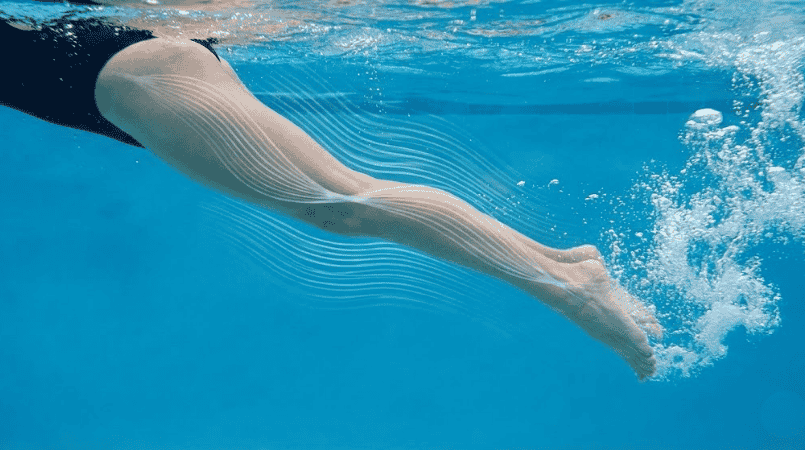
Physics of propulsion vs. drag: Every movement in water creates both forward propulsion and backward drag. The key is maximizing the former while minimizing the latter. Your kick generates propulsion primarily during the downbeat, when your foot accelerates water backward. However, a rigid ankle or bent knee creates significant drag that cancels out propulsive gains.
Hydrodynamics of foot positioning: Your feet act like flexible fins, and their angle determines efficiency. Proper plantar flexion (pointed toes) creates a streamlined profile during the upbeat and maximum surface area during the downbeat. Even a few degrees of difference in foot angle can significantly impact your speed.
Muscle Anatomy & Function
Primary muscle groups: Your hip flexors (iliopsoas) initiate the downbeat, while your glutes and hamstrings power the upbeat. The quadriceps provide stabilization and contribute to the downbeat’s finishing phase. Your core muscles maintain body position throughout the kick cycle.
Secondary muscle groups: Often overlooked, your calf muscles and the intrinsic muscles of your feet provide the ankle flexibility essential for efficient kicking. Your lower back muscles work continuously to maintain proper body alignment.
The Three Critical Functions
Your kick serves three simultaneous purposes that work together to create efficient swimming.
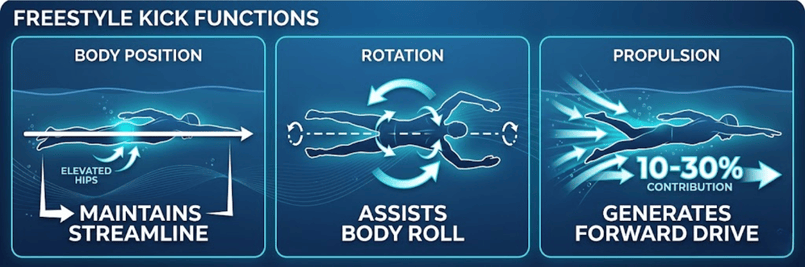
Body position maintenance: A consistent kick keeps your hips elevated and your body horizontal. Without it, your legs sink, creating massive drag that forces your arms to work exponentially harder.
Rotation assistance: As you rotate from side to side during your stroke, your kick provides counterbalance and helps drive rotation. This creates the rhythmic, connected stroke pattern characteristic of efficient freestyle stroke.
Direct propulsion: While contributing less forward drive than your pull, your kick still generates 10-30% of your total propulsion depending on distance and intensity.
Mastering Kick Mechanics
The Two-Phase System
Downbeat mechanics: The power phase begins at your hip with a straight leg. As your leg descends, your knee bends slightly (about 30-40 degrees) to create a whip-like motion. Your foot accelerates through the water, finishing with toes pointed and pressure felt along the top of your foot. The key is initiating from the hip rather than the knee.
Upbeat preparation: This recovery phase positions your leg for the next downbeat. Your leg straightens as it rises, with your foot remaining relaxed and toes pointed. The upbeat requires less power than the downbeat but maintains rhythm and body position.

Timing Patterns Explained
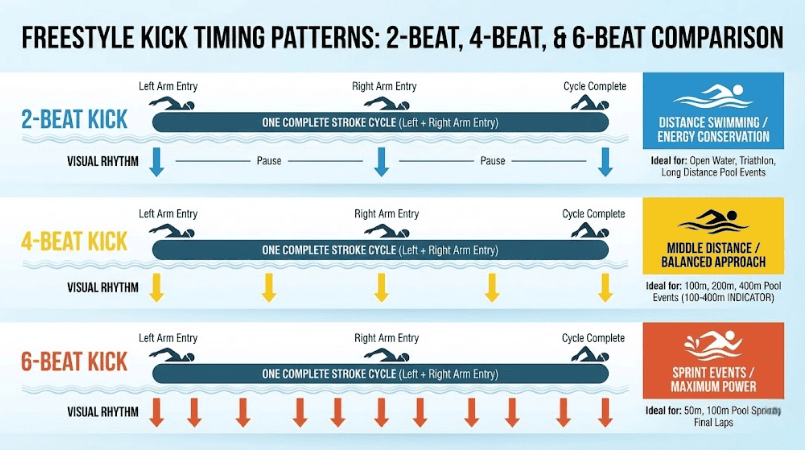
The relationship between your kick and arm stroke creates distinct patterns suited to different swimming scenarios.
Two-beat kick: One downbeat per arm stroke (two kicks per complete stroke cycle). This pattern works for distance swimming where energy conservation is paramount. The kick primarily maintains body position and assists rotation rather than generating propulsion. Distance swimmers and triathletes commonly use this pattern to save leg energy for the run.
Four-beat kick: Two downbeats per arm stroke, though timing varies. Some swimmers use it continuously while others alternate between two-beat and six-beat depending on race phase. This moderate pattern balances propulsion and energy expenditure for middle-distance events.
Six-beat kick: Three downbeats per arm stroke creates the most propulsive but energy-intensive pattern. Sprinters rely on this pattern for maximum speed. The continuous kick maintains optimal body position and generates significant propulsion throughout the race.
Common Kicking Mistakes
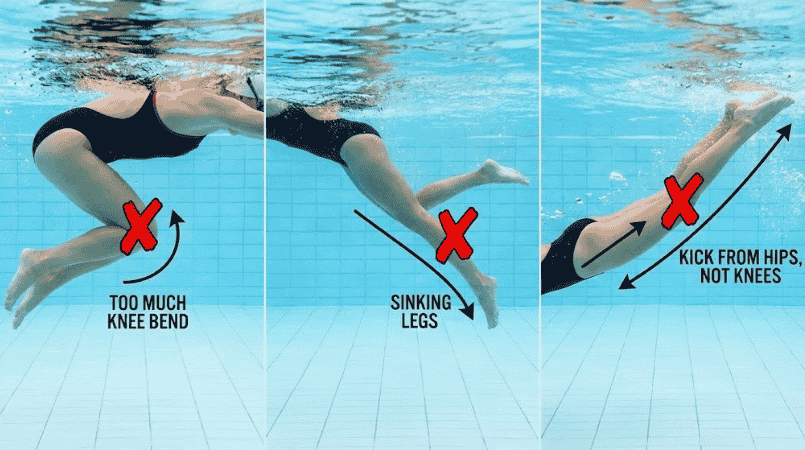
There are lots of common mistakes in freestyle swimming. Below I have mentioned some common kicking related mistakes that many swimmers make. Lets dive deeper…..
The Big Three Errors
Knee-driven kicking: Bending excessively at the knee rather than initiating from the hip creates a bicycling motion that generates massive drag. This mistake stems from tight hip flexors or misunderstanding proper technique. Your knee should bend naturally during the downbeat, but the movement originates at your hip.
Surface breaking: When your feet exit the water during the upbeat, you create splash rather than propulsion. This wastes energy and signals that your hips are dropping. Proper body position keeps your kick entirely underwater, with just your heels occasionally breaking the surface.
Timing disconnection: When your kick rhythm doesn’t coordinate with your arm stroke and breathing, your entire stroke becomes disjointed and inefficient. This usually manifests as pausing or irregular kicking, particularly during breathing.
How to Identify Your Specific Kicking Issues
Film yourself swimming from side and below angles. Watch for excessive knee bend, splashing feet, or dropped hips. Ask a coach or experienced swimmer to observe your kick rhythm during breathing. Use a snorkel for extended kick-only sets to isolate and analyze your kick without breathing interruption. Pay attention to how quickly you fatigue during kick sets compared to pull sets.
Strategic Kick Application
Distance-Specific Strategies
Sprint (50m) approach: Maximum intensity six-beat kick from start to finish. Your legs contribute significant propulsion, and the race ends before serious fatigue sets in. Focus on explosive power and maintaining kick tempo even as lactate builds.
Middle distance (100-400m) tactics: Start with aggressive six-beat kicking off the blocks and through the first length. Transition to four-beat or modified six-beat for the middle section, then return to full six-beat for the final 25-50 meters. This strategy balances propulsion with energy management.
Distance (800m+) conservation: Primarily two-beat kicking with brief six-beat bursts for turns and strategic accelerations. Your kick maintains body position and assists rotation while conserving energy for your pull and the final sprint.

Race Tactics Integration
Start and turn acceleration: Explosive underwater kicking off starts and turns provides your fastest swimming of any race. Many elite swimmers generate more speed underwater than on the surface. Practice aggressive dolphin kicks transitioning to flutter kicks as you break out.
Mid-race positioning: Use your kick strategically to respond to competitors. A temporary increase in kick tempo allows you to close gaps or break away without dramatically increasing arm tempo.
Finish sprint timing: Begin increasing kick intensity 25-50 meters from the wall depending on your event distance. Your final sprint should feature maximum six-beat kicking coordinated with increased arm tempo.
Training Periodization
Structure your kick training to peak at key competitions. During base training phases, emphasize technique and endurance with longer kick sets at moderate intensity. Pre-competition phases incorporate race-pace kick intervals and starts/turns practice. Taper periods maintain kick sharpness with shorter, high-quality sets while reducing overall volume.
Equipment & Technology Guide
Traditional Training Aids
Kickboard: The classic tool isolates your kick but can encourage dropped hips if overused. Hold the front edge lightly rather than gripping the sides to maintain better body position.
Fins: These extend your foot’s surface area, allowing you to feel proper mechanics and build strength. Start with shorter fins for technique work and progress to longer fins for power development.
Pull buoy (negative training): Occasionally swimming with a pull buoy highlights how much your kick normally contributes. This contrast helps you appreciate the kick’s role in your complete stroke.
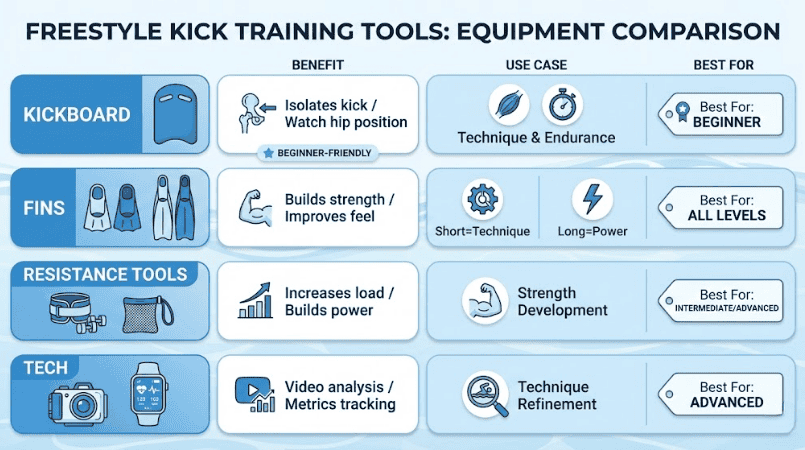
Resistance Tools Comparison
Resistance equipment builds kick-specific strength and power. Ankle weights create constant resistance throughout the kick cycle. Resistance bands attached to the wall allow stationary kick training with progressive resistance. Drag socks slip over your feet to increase resistance while maintaining normal range of motion.
Modern Technology Integration
Underwater cameras: Video analysis reveals technical flaws invisible from the deck. Position cameras at side, front, and below angles to capture your complete kick mechanics. Review footage at slow motion to identify specific issues.
Stroke analysis apps: Applications like Coach’s Eye or Hudl Technique allow frame-by-frame analysis and comparison with elite swimmers. Draw angles and lines to measure knee bend, ankle position, and kick depth.
Wearable tech for kick metrics: Devices like Garmin swim watches or Tritonwear sensors measure kick rate, stroke count, and underwater time. This objective data helps track improvement and optimize race strategy.
DIY vs. Professional Equipment
Budget-conscious swimmers can achieve excellent results with minimal investment. A basic kickboard and inexpensive fins cover most training needs. Use your phone in a waterproof case for video analysis rather than expensive camera systems. As you advance and identify specific weaknesses, invest in targeted equipment that addresses those areas.
Improvement Drills for Your Kick
Foundation Drills
Streamline back kicking: Push off the wall on your back in streamlined position, kicking continuously. This drill develops kick power and endurance while allowing you to watch your feet for technique feedback. Maintain tight streamline throughout.
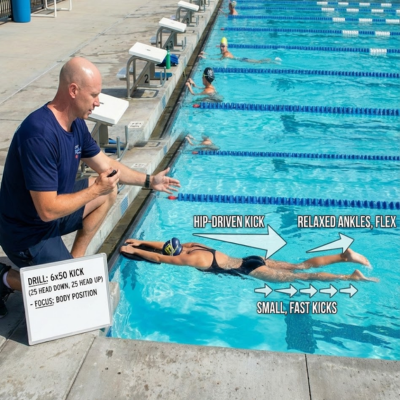
Vertical kicking: Treading water using only your flutter kick with arms crossed or overhead develops power and strengthens the muscles that maintain body position. Progress to holding weights above water for advanced training.
Side kicking: Kick on your side with bottom arm extended and top arm at your side. This drill improves body rotation awareness and develops the kick rhythm needed for efficient freestyle. Alternate sides every 25 meters.
Wall kick variations: Hold the wall or gutter and practice different kick tempos, depths, and intensities. Focus on initiating movement from your hips and maintaining pointed toes. This allows unlimited practice without breathing interruption.
Snorkel kick progressions: Swimming with a snorkel eliminates breathing disruption, allowing you to focus entirely on kick technique and rhythm. Start with kick-only sets, progress to single-arm swimming, then full stroke with heightened kick awareness.
Importance of Dryland Training for Kicking
Flexibility & Mobility
Ankle sit progressions: Kneel with tops of feet flat on the ground and slowly sit back on your heels. This stretches the ankle into the plantar flexion position essential for efficient kicking. Start with partial range and progress to full sits as flexibility improves. Hold for 30-60 seconds, performing 3-5 repetitions.
Dynamic warm-up routines: Before swimming, perform leg swings (forward/back and side-to-side), walking lunges, and ankle circles. These movements prepare your muscles and joints for the demands of kicking while improving long-term flexibility.
Strength Development
Goblet squat variations: Hold a weight at chest level and squat deeply, focusing on glute and quadriceps engagement. This builds the hip and thigh strength essential for powerful kicking. Perform 3-4 sets of 8-12 repetitions with controlled tempo.
Single-leg training: Bulgarian split squats, single-leg deadlifts, and step-ups develop unilateral strength and address imbalances between legs. These exercises also improve the stability and coordination needed for efficient kicking.
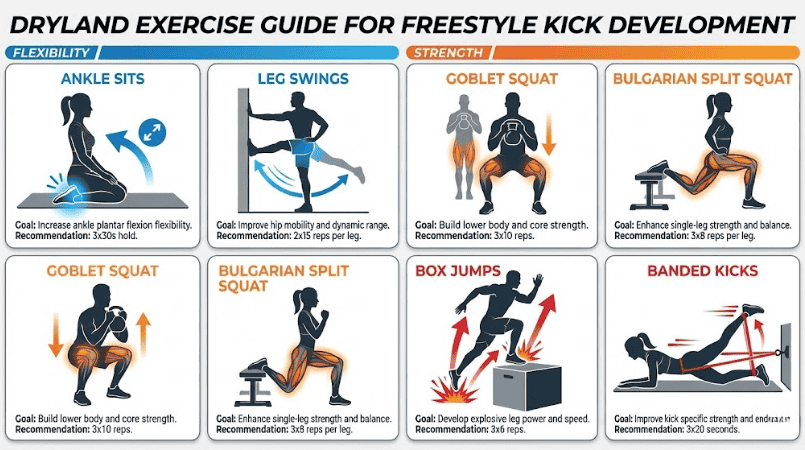
Power development: Box jumps, broad jumps, and banded kick exercises develop the explosive power needed for sprint kicking. Focus on quality over quantity, performing 3-5 sets of 3-5 repetitions with full recovery between sets.
Kick-Specific Conditioning
Plyometric progressions: Begin with low-intensity movements like ankle hops and progress to more demanding exercises like single-leg bounds. These develop the rapid force production needed for high-tempo kicking.
Endurance protocols: Circuit training combining bodyweight exercises like squats, lunges, and calf raises builds the muscular endurance needed for maintaining kick tempo throughout longer events. Perform 30-45 second intervals with minimal rest.
Recovery methods: Foam rolling, stretching, and contrast therapy (alternating hot and cold water) accelerate recovery between training sessions. Priority areas include hip flexors, glutes, hamstrings, quadriceps, and calves.
Common Kick-Related Injuries
Injury Types and Causes
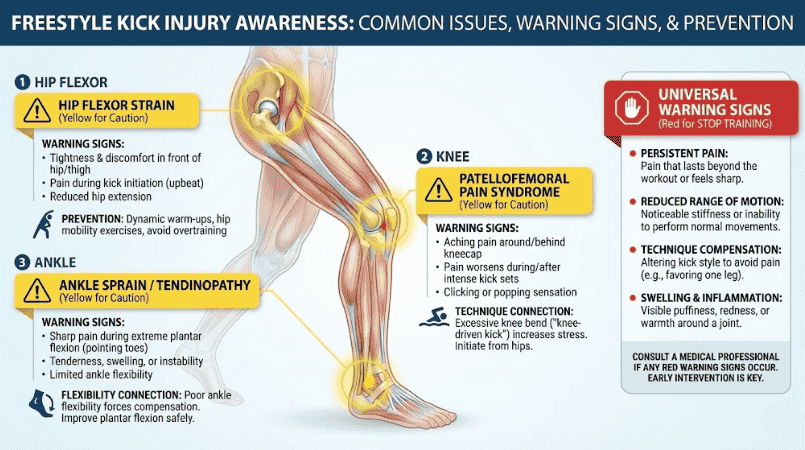
Ankle strains: Repetitive plantar flexion under resistance can strain ankle ligaments and tendons. This particularly affects swimmers transitioning to increased kick volume or intensity too rapidly.
Knee stress: Improper knee-driven kicking places excessive stress on knee ligaments and the patellofemoral joint. This manifests as pain during or after kick-intensive training.
Hip flexor issues: The hip flexors work constantly during kicking, making them vulnerable to overuse injuries. Tight hip flexors also limit kick efficiency and increase injury risk.
Prevention Protocols
Warm-up essentials: Never begin intensive kick training without proper warm-up. Start with easy swimming, progress to dynamic stretching, then gradually increase kick intensity over 10-15 minutes.
Recovery strategies: Include rest days in your training schedule and ensure adequate sleep. Use recovery techniques like massage, stretching, and ice baths after particularly demanding sessions. Cross-training with low-impact activities like cycling maintains fitness while reducing repetitive stress.
Warning sign recognition: Address minor discomfort immediately before it progresses to serious injury. Persistent pain, swelling, reduced range of motion, or technique changes all signal potential problems requiring attention.
Return-to-Swimming Guidelines
Progressive loading: After injury, resist the temptation to immediately return to previous training volume. Begin with 25-50% of normal kick volume and increase by no more than 10% weekly. Focus on technique rather than intensity during initial sessions.
Modified training approaches: Use fins to reduce ankle stress, perform pull-only sets to maintain fitness, and emphasize upper-body training while your kick heals. Some swimming is better than no swimming.
How to Recover Faster from Kicking Injuries
Recovery speed depends on injury severity and your response. Immediately apply RICE principles (rest, ice, compression, elevation) for acute injuries. Consult sports medicine professionals for persistent issues rather than self-diagnosing. Maintain fitness through modified training and address underlying causes like technique flaws or flexibility limitations. Patient, systematic rehabilitation prevents re-injury and builds a more resilient body.
Nutritional Support for Kick Performance
Pre-Training Nutrition
Consume easily digestible carbohydrates 60-90 minutes before training to fuel intensive kick sets. Options include bananas, oatmeal, or energy bars. Stay hydrated throughout the day, not just immediately before swimming. Chronic dehydration impairs muscle function and increases injury risk.
Recovery Nutrition
Consume protein and carbohydrates within 30 minutes after demanding kick training. This window optimizes muscle repair and glycogen replenishment. Chocolate milk, protein shakes, or Greek yogurt with fruit provide convenient recovery nutrition. Continue eating balanced meals throughout the day to support adaptation and recovery.
Supplements for Leg Strength
Evidence-based recommendations: Creatine monohydrate improves power output for sprint kicking when taken consistently (3-5 grams daily). Beta-alanine may improve performance in middle-distance events by buffering lactate accumulation. Omega-3 fatty acids support joint health and reduce inflammation.
Timing considerations: Creatine timing doesn’t significantly impact effectiveness; consistent daily consumption matters most. Take beta-alanine with meals to minimize tingling sensations. Consume omega-3s with fat-containing meals for optimal absorption.
Integration with Complete Stroke
Breathing Coordination
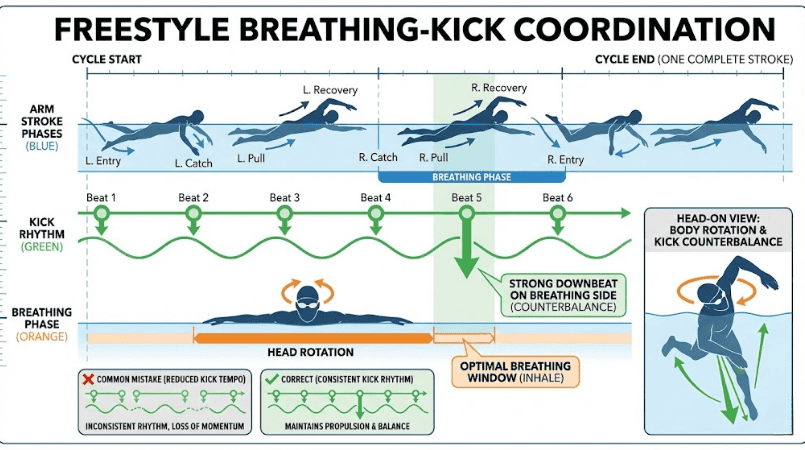
Bilateral breathing impact: Breathing every three strokes creates symmetrical stroke rhythm and encourages balanced kicking. Some swimmers unconsciously reduce kick tempo during breathing; practice maintaining consistent kick rhythm throughout your breathing cycle.
Breath timing with kick: Coordinate your breathing with specific kick beats to establish rhythm. Many swimmers find breathing just after a strong downbeat on their breathing side helps maintain body rotation and prevents interrupting kick flow.
Cross-Training Benefits
Backstroke kick carryover: Backstroke kicking develops similar muscles through different ranges of motion, providing balanced development. The visible feet in backstroke also allow direct technique observation and correction.
Butterfly kick foundation: Although different from flutter kick, butterfly kick develops core strength, ankle flexibility, and power that transfer to improved freestyle kicking. Many swimmers practice butterfly kick on their front or back as cross-training.
How to Future-Proof Your Kick
Emerging Training Methods
Innovative drill variations: Experiment with asymmetrical kicking patterns, such as emphasizing one leg while maintaining normal rhythm with the other. This develops strength and coordination simultaneously. Try combining kick patterns within single lengths, such as six-beat transitioning to two-beat.
Technology integration: Virtual reality training systems now allow swimmers to practice technique on land with real-time feedback. Underwater treadmills provide resistance training impossible in conventional pools. Stay informed about developing technologies that might benefit your training.
The swimming community continuously develops new training approaches. Follow elite swimmers and coaches on social media, attend clinics and workshops, and remain open to modifying your technique based on new evidence. The swimmers who continuously refine their approach based on emerging knowledge maintain competitive advantages throughout their careers.
Conclusion
Your freestyle kick represents far more than a simple up-down leg movement. It’s a sophisticated system involving multiple muscle groups, precise timing, and strategic application that varies based on event distance and race tactics. Mastering your kick requires understanding the underlying science, dedicating time to technique development, and strategically applying different patterns based on your goals.
Whether you’re pursuing podium finishes or personal bests, your kick provides the foundation for everything else in your stroke. The swimmers who invest time developing efficient, powerful kicks discover that improvement accelerates across all aspects of their swimming. Start with the fundamentals, progressively build strength and endurance, and consistently refine your technique through video analysis and coaching feedback.
Your perfect kick awaits beneath the surface. With dedicated practice guided by the principles outlined here, you’ll transform your freestyle from merely functional to genuinely fast. The water is waiting, start kicking your way to better swimming today
Looking for a swimming Club in Toronto?
Rocket swim is here with the best coaches and facilities. Come and visit our club, We can assure you’ll love it. See you in the next blog