

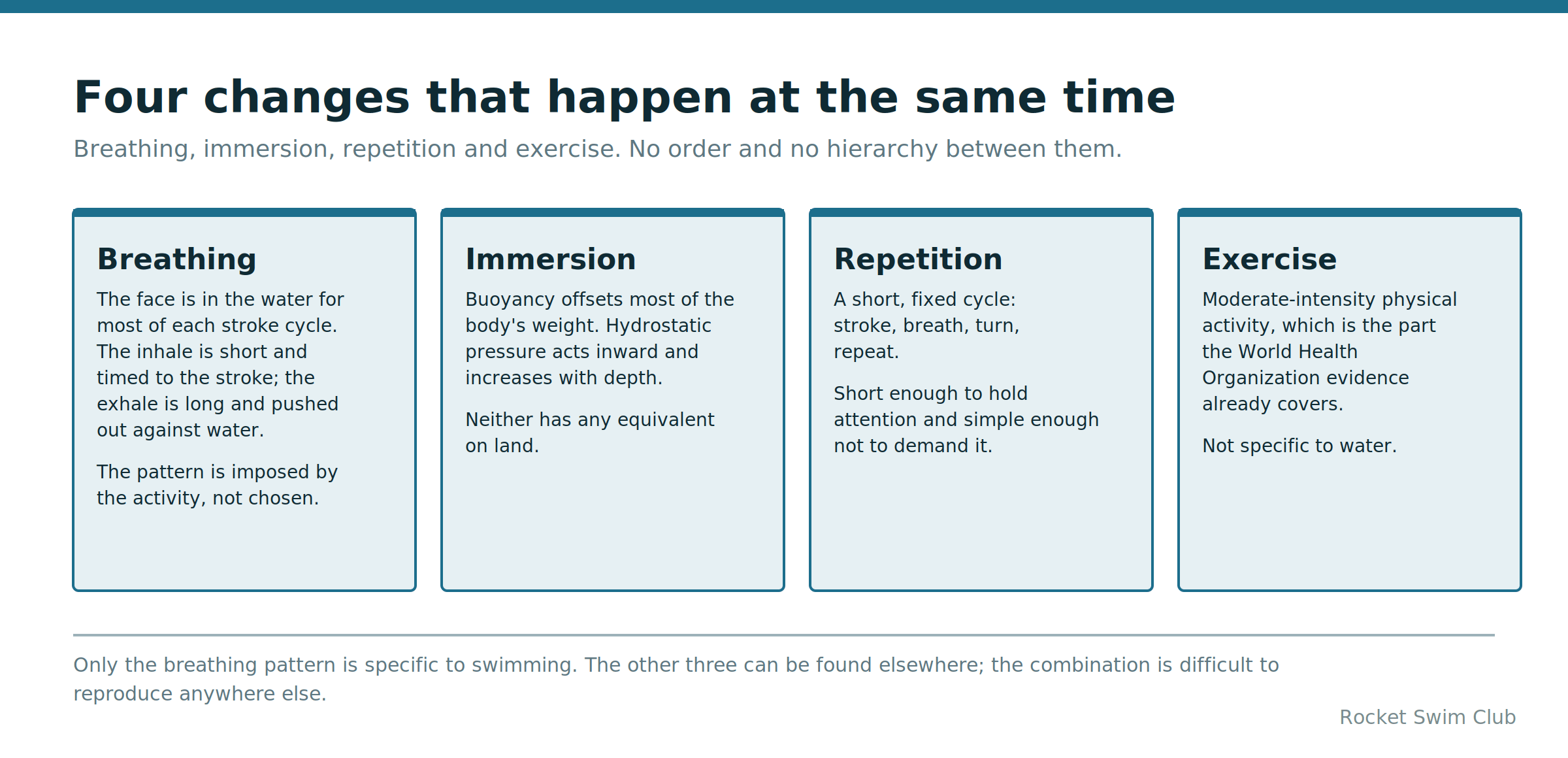
Swimming is associated with better mental wellbeing, lower stress and better sleep, and the reason is physical before it is psychological. Water changes four things at once: it forces a slow, timed breathing pattern, it takes weight off the body while pressing on it, it makes the activity repetitive, and it is exercise. Each of those is measurable on its own. Together they describe why people who swim regularly report that a session clears their head, and why that report is so consistent across swimmers who have nothing else in common.
This page covers what the research does and does not show, the four mechanisms in order, what is specific to water rather than to exercise generally, sleep, and how often to swim. The World Health Organization recommends at least 150 minutes of moderate-intensity physical activity a week, which is the only frequency figure with real authority behind it. Nothing here is a treatment claim, and one section is devoted entirely to what swimming does not do.
Is Swimming Good for Mental Health?
Swimming is a form of moderate-intensity physical activity, and physical activity is associated with lower reported symptoms of anxiety and depression. The World Health Organization, in its physical activity fact sheet dated 26 June 2024, states that regular physical activity “reduces symptoms of depression and anxiety, enhances brain health, and can improve overall well-being”.
“Associated with” is doing real work in that sentence. It means people who are more active report fewer symptoms. It does not mean a given swim produces a given change in a given person.
Research on swimming specifically is thinner than the volume of writing about it suggests. A 2026 systematic review by Shimeng Huang in Frontiers in Psychology examined 16 studies of swimming and aquatic activity, and concluded that “aquatic participation mitigates anxiety and depressive symptomatology while strengthening cognitive flexibility, affective balance, and overall well-being”. That review covered children, adolescents and youth rather than adults, and its authors name their own limits directly: gaps in “methodological rigor, intervention duration, and the neuropsychological underpinnings of aquatic engagement”.
The honest summary is that the general finding is well supported and the swimming-specific finding is promising and under-researched.
Why Does Swimming Affect How You Feel?
Swimming affects how a person feels through four changes that happen at once: a controlled breathing pattern, immersion, repetition, and exercise itself. No single one of those is unique to swimming. The combination is difficult to reproduce anywhere else.
The first, and the one most specific to swimming, is breathing.
How Breathing Changes When You Swim
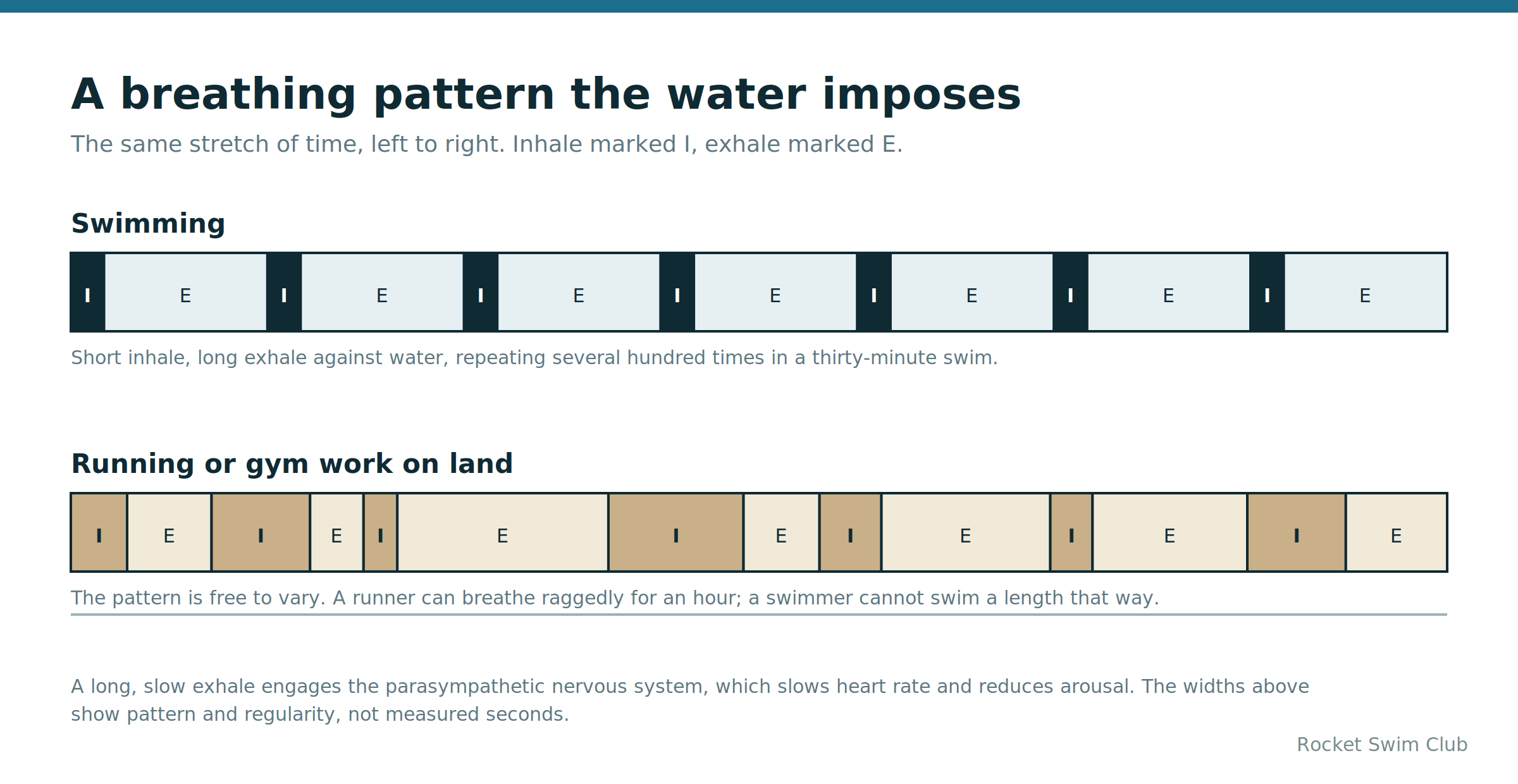
A swimmer cannot breathe whenever they want. The face is in the water for most of each stroke cycle, so the inhale is short and timed to a specific point in the stroke, and the exhale is long and pushed out against water. The pattern is not chosen. It is imposed by the activity, and it repeats several hundred times in a thirty-minute swim.
That matters because a long, slow exhale is one of the few voluntary actions that reliably engages the parasympathetic nervous system, the branch of the autonomic nervous system that slows heart rate and reduces physiological arousal. Land exercise does not force this pattern. A runner can breathe raggedly for an hour. A swimmer cannot swim a length that way.
Cortisol, the body’s primary stress hormone, appears constantly in writing about swimming and stress. The evidence base behind those claims is weaker than the confidence with which they are made, and the most frequently cited swimming-and-cortisol research studied overtrained competitive swimmers, which is close to the opposite of a recreational adult doing steady lengths. No cortisol figure appears on this page for that reason.
What Buoyancy and Hydrostatic Pressure Do to the Body
Buoyancy is the upward force water exerts on a submerged body, which offsets most of its weight. Hydrostatic pressure is the force water exerts inward on a submerged body, and it increases with depth. Both act on a swimmer continuously, and neither has any equivalent on land.
Their circulatory effects are well documented. Weenink and Wingelaar, writing in Frontiers in Physiology in 2021, describe “approximately 500-700 ml increase in circulating volume as measured during submersion”, caused by buoyancy counteracting gravity and reducing the normal pressure gradient that pushes fluid out of vessels into tissue. The same paper describes the mammalian diving reflex, in which facial contact with water produces “parasympathetic stimulation leading to bradycardia, apnea, and vasoconstriction”. Those reflex effects are transient, “dissolving after approximately 5-10 min”.
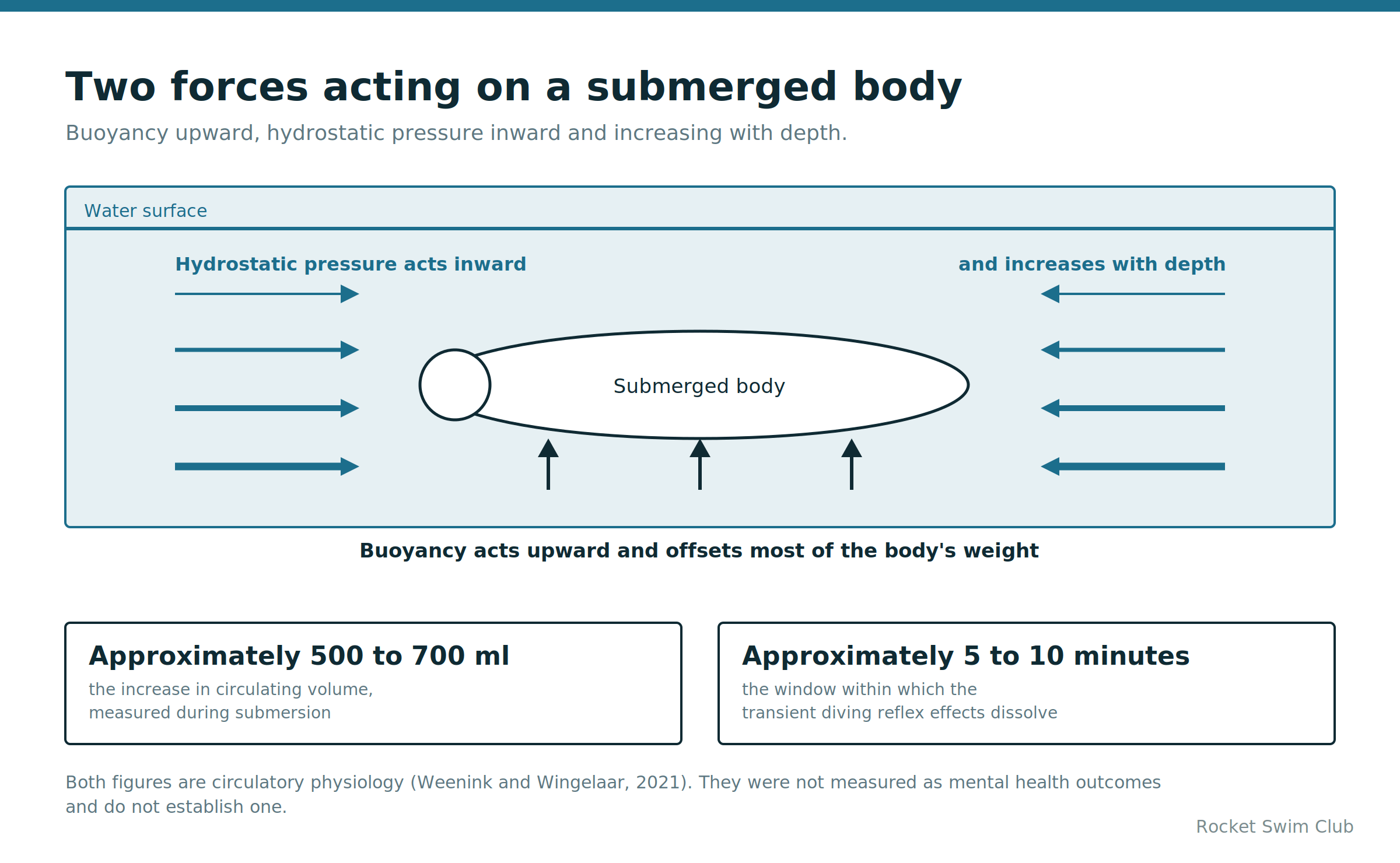
That research is circulatory physiology. It was not measured as a mental health outcome, and it does not establish one. What it establishes is that immersion is a genuine physiological state rather than a figure of speech, which is the honest basis for saying that water does something to the body that a treadmill does not.
Buoyancy also does something simpler. It removes the sensation of body weight. For a swimmer carrying tension, stiffness or self-consciousness, thirty minutes without the feeling of weight on the joints is the most immediately noticeable thing about being in a pool.
Buoyancy and pressure act on the body. Rhythm acts on attention.
Why Repetition and Rhythm Matter
Swimming lengths is a repetitive task with a fixed cycle. Stroke, breath, turn, repeat. The cycle is short enough to hold attention and simple enough not to demand it, which is the combination swimmers describe when they call swimming a moving meditation.
That phrase is a description swimmers use, not a clinical term, and it should be read as one. What is factual is narrower: a repetitive activity with a fixed cycle and a countable structure gives attention something regular to attach to. Counting lengths is the most common version of this, and swimmers lose count constantly, which is itself the reported point.
The fourth change, exercise itself, is the one the WHO evidence above already covers. What water adds on top of it is mostly a matter of what it takes away.
What Makes Swimming Different From Other Exercise for Stress?
Swimming differs from land exercise in three ways that are specific to being in water. Each removes a source of input rather than adding one:
- No screen. A phone cannot come into the pool. For many adults a swim is the longest stretch of the day spent away from a device, and that is a feature of the environment rather than of the exercise.
- No audio. Music, podcasts and calls are not practical for most lane swimmers. The sound is water and breathing.
- A restricted visual field. Goggles and the surface reduce what a swimmer can see to a black line and a wall. There is very little to look at.
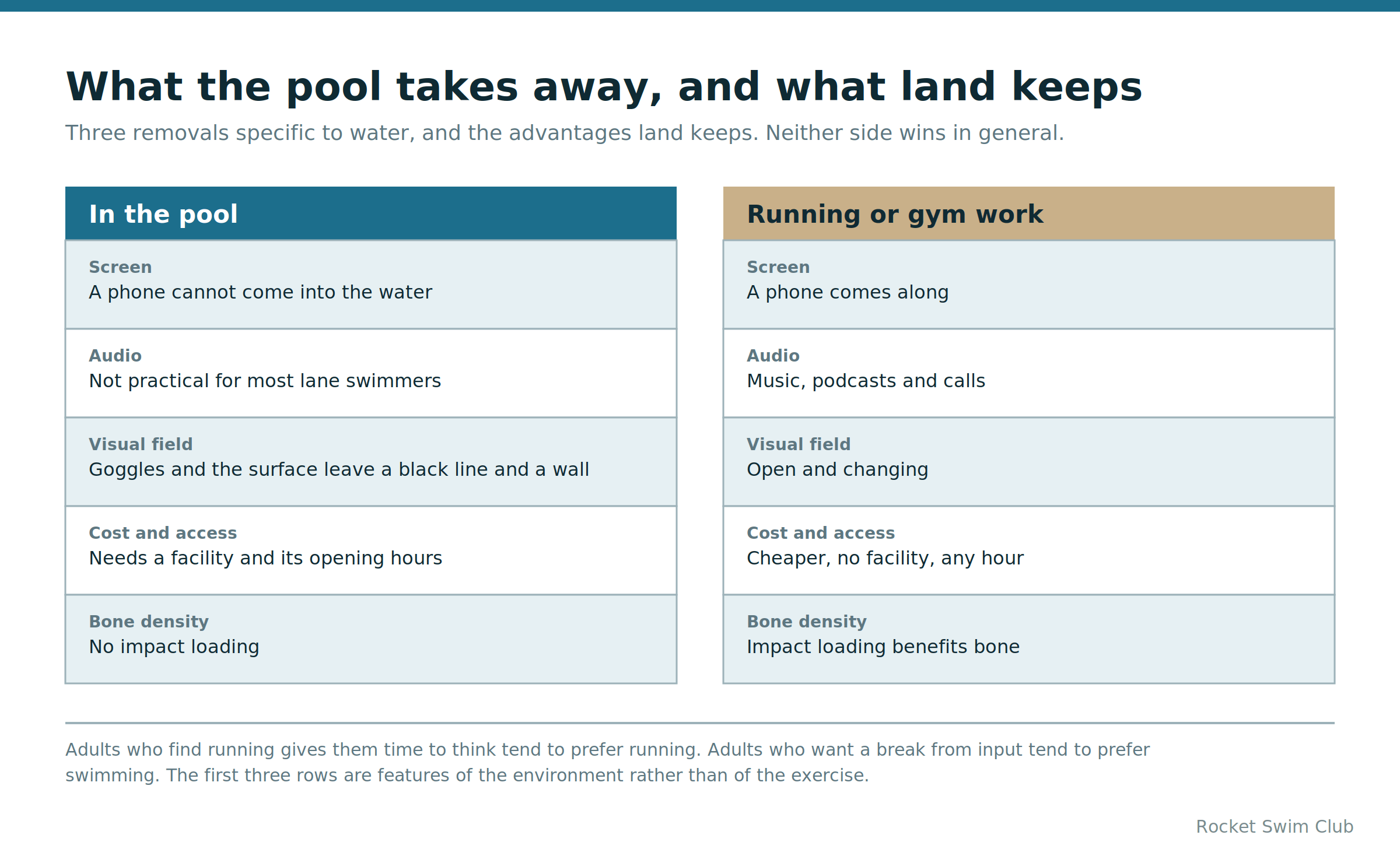
Running and gym training have real advantages swimming does not. They are cheaper, they need no facility, they can be done at any hour, and their impact loading benefits bone density in a way swimming does not. The point is not that swimming wins. The point is that the three removals above are difficult to get anywhere else, and a reader who wants a break from input rather than a better workout is choosing on that basis.
The wider case for swimming as exercise, including its cardiovascular and physical benefits, is set out on the benefits of swimming page.
One reported effect of that combination shows up hours later, at night.
Does Swimming Help You Sleep Better?
Regular exercise is associated with better self-reported sleep quality, and swimming is regular exercise. A 2025 systematic review and meta-analysis by Li and colleagues in Frontiers in Medicine pooled 26 randomised controlled trials covering 2,189 older adults and found that “exercise interventions significantly improved subjective sleep quality” as measured on the Pittsburgh Sleep Quality Index.
Two limits sit on that finding. The trials studied exercise in general, not swimming specifically. And the participants were older adults, so the result does not automatically transfer to a thirty-year-old.
What can be said plainly is that swimming is exercise of the kind those trials examined, performed at a moderate intensity, usually at a consistent time of day. Adults who take up regular lane swimming commonly report falling asleep faster. That is a widespread report rather than a measured swimming-specific result, and it is worth saying which of the two it is.
Any effect on sleep or stress depends on swimming often enough to be a habit.
How Often Should You Swim for Mental Health?
There is no swimming-specific frequency recommendation, so the general physical activity guidance applies. The World Health Organization recommends at least 150 minutes of moderate-intensity physical activity per week for adults. In pool terms that is:
- Three swims of 50 minutes
- Four swims of 40 minutes
- Five swims of 30 minutes
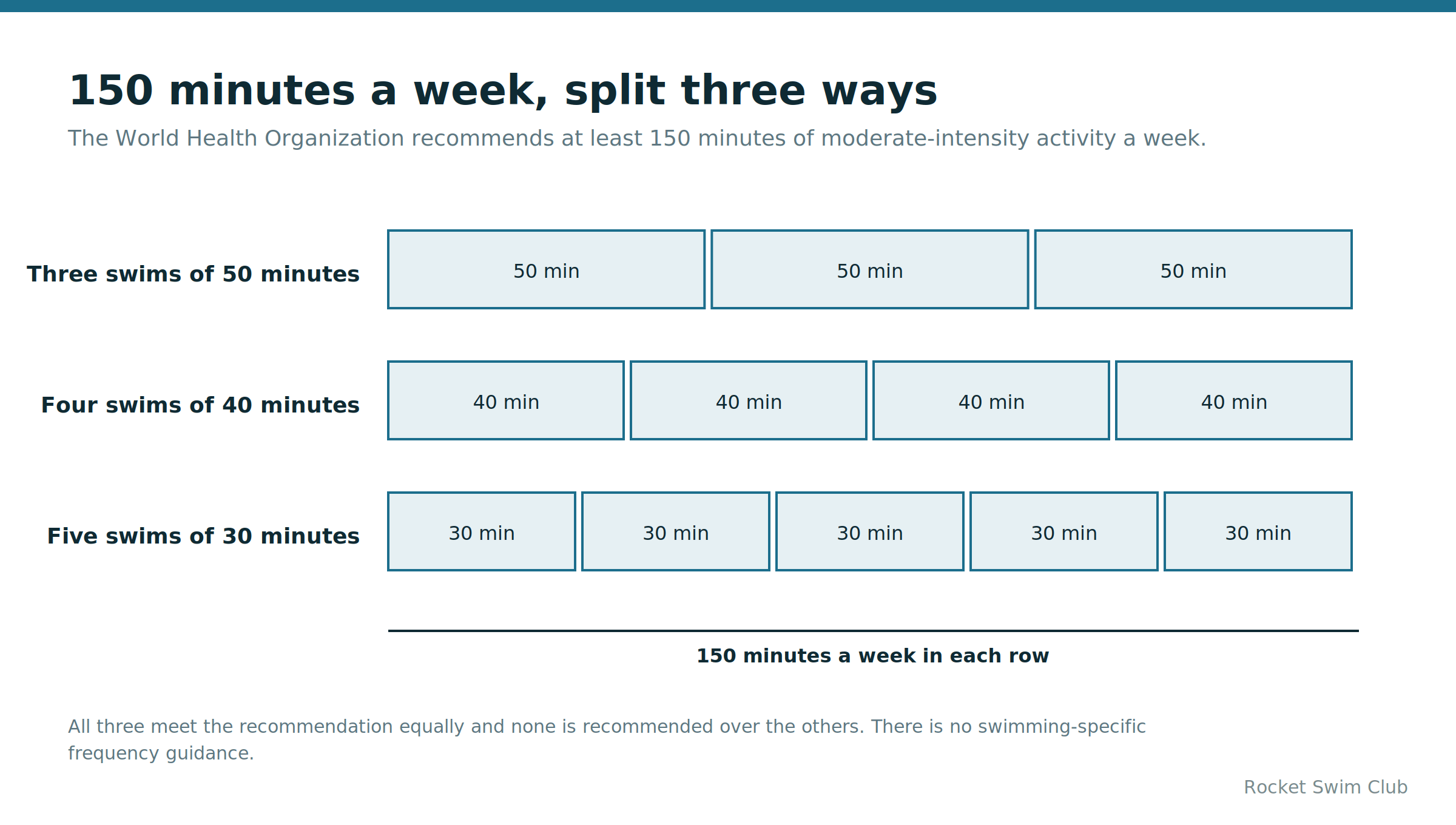
Any of the three meets the recommendation. The most useful of them is whichever an adult will still be doing in three months, which is usually the one that fits an existing week rather than the one that looks most serious.
Consistency matters more than session length here, and it is mostly a scheduling problem rather than a fitness one. Rocket Swim Club runs adult sessions at pools across Toronto’s west end throughout the week, including evenings, keeps availability through holidays and summer, and allows sessions to be rescheduled online, which removes the most common reason an adult swimming habit ends after five weeks.
An adult who wants structure rather than an empty lane, or who is not yet swimming comfortably enough for a continuous 30 minutes, is better served by adult swimming lessons than by a pool pass.
What a Realistic First Month Looks Like
The first few sessions are usually effortful rather than restorative. An adult returning to swimming after years away spends the first two or three swims out of breath, stopping at every wall, and thinking about technique rather than about nothing. The calm that swimmers describe arrives once the stroke is automatic enough to stop occupying attention, and that takes a different number of sessions for every person.
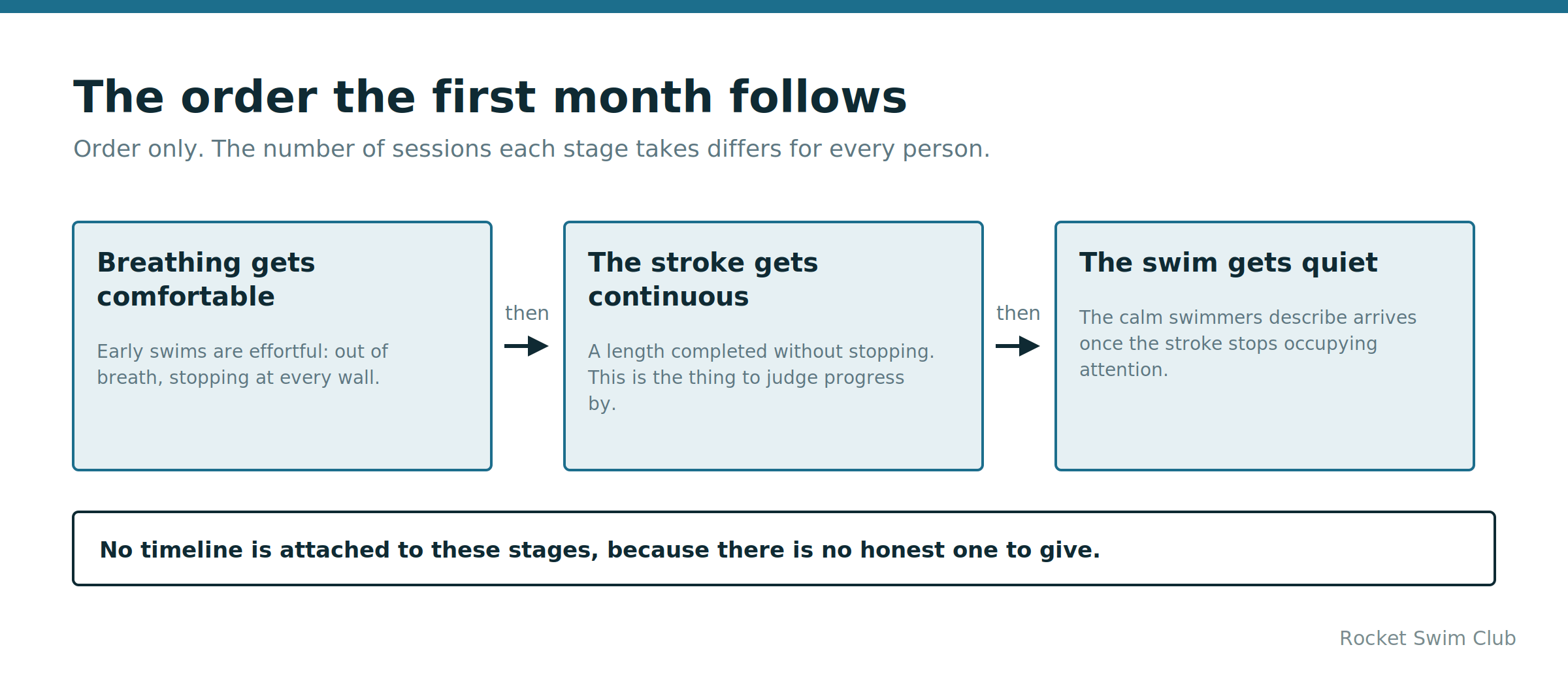
There is no honest timeline to give. What is predictable is the order: breathing gets comfortable, then the stroke gets continuous, then the swim gets quiet. A swimmer judging progress in the first month should look at whether they can complete a length without stopping, not at how they feel afterwards.
Frequency is the practical limit. There is an honest limit as well.
What Swimming Does Not Do
Swimming is not a treatment for any mental health condition. It does not cure anxiety, it does not treat depression, and no amount of it substitutes for care from a qualified professional. Anyone experiencing persistent low mood, anxiety that interferes with daily life, or a change in sleep that does not resolve should speak to a doctor or a qualified mental health professional. In Canada, anyone in crisis can call or text 9-8-8 at any time.
The research picture deserves the same honesty. Most swimming-specific studies are small. Many rely on self-report. The 2026 Frontiers in Psychology review named above studied young people, not adults, and its authors flagged their own methodological gaps. The strongest evidence in this area is about physical activity in general, and swimming inherits that evidence by being physical activity rather than by being water.
None of that makes swimming less worth doing. It makes the reason for doing it different. Swimming is a repetitive, absorbing, low-input activity that most people can do for decades and that leaves them feeling better afterwards. That is a good enough reason on its own, and it does not require a claim that would not survive being checked.
Common Questions About Swimming and Wellbeing
Is swimming good for anxiety?
It can help with everyday stress and anxious feelings, in the same way other regular moderate exercise does. The WHO lists reduced symptoms of anxiety among the benefits of regular physical activity, and swimming adds a slow, long-exhale breathing pattern that most people would otherwise have to practise deliberately. It is not a treatment for an anxiety disorder, for the reasons set out in the section above.
Is swimming better than running for stress?
Neither is better in general. Running is more accessible, more intense per minute, and loads bone in a way swimming does not. Swimming removes screens, audio and most of the visual field, and imposes a breathing pattern a runner has to choose deliberately. Adults who find running gives them time to think tend to prefer running. Adults who want to stop thinking tend to prefer swimming.
What if you cannot swim well enough to do lengths?
Very little of what this page describes requires a good stroke. The breathing pattern, the buoyancy and the repetition are all present in a slow, inefficient front crawl covering 25 metres at a time. What is not present is continuity, and that is the part that has to be built. An adult in that position needs instruction rather than pool time, and Rocket Swim Club’s swimming lessons start from any level of ability.
Does swimming release endorphins?
Sustained moderate exercise, including swimming, is associated with endorphin release. The word is used far more loosely than the evidence supports, and the pleasant feeling after a swim involves several systems rather than one hormone. Endorphins are part of the picture. They are not the explanation.
Is it normal to feel worse after a swim?
Yes, and it is common in the first few weeks. Fatigue, irritability and a headache after swimming usually come from underestimating the effort, from not drinking enough, or from swimming harder than intended because a lane forces a pace. It normally settles as the stroke becomes efficient. A swimmer who consistently feels worse rather than better after swimming should stop treating the pool as the fix and speak to a doctor.