
A swimming stroke is a repeatable pattern of arm and leg movements that moves a swimmer through the water while they keep breathing. Beginners usually find the easiest strokes are the ones that leave the face clear of the water, because breathing is the part that makes swimming feel hard, not strength.
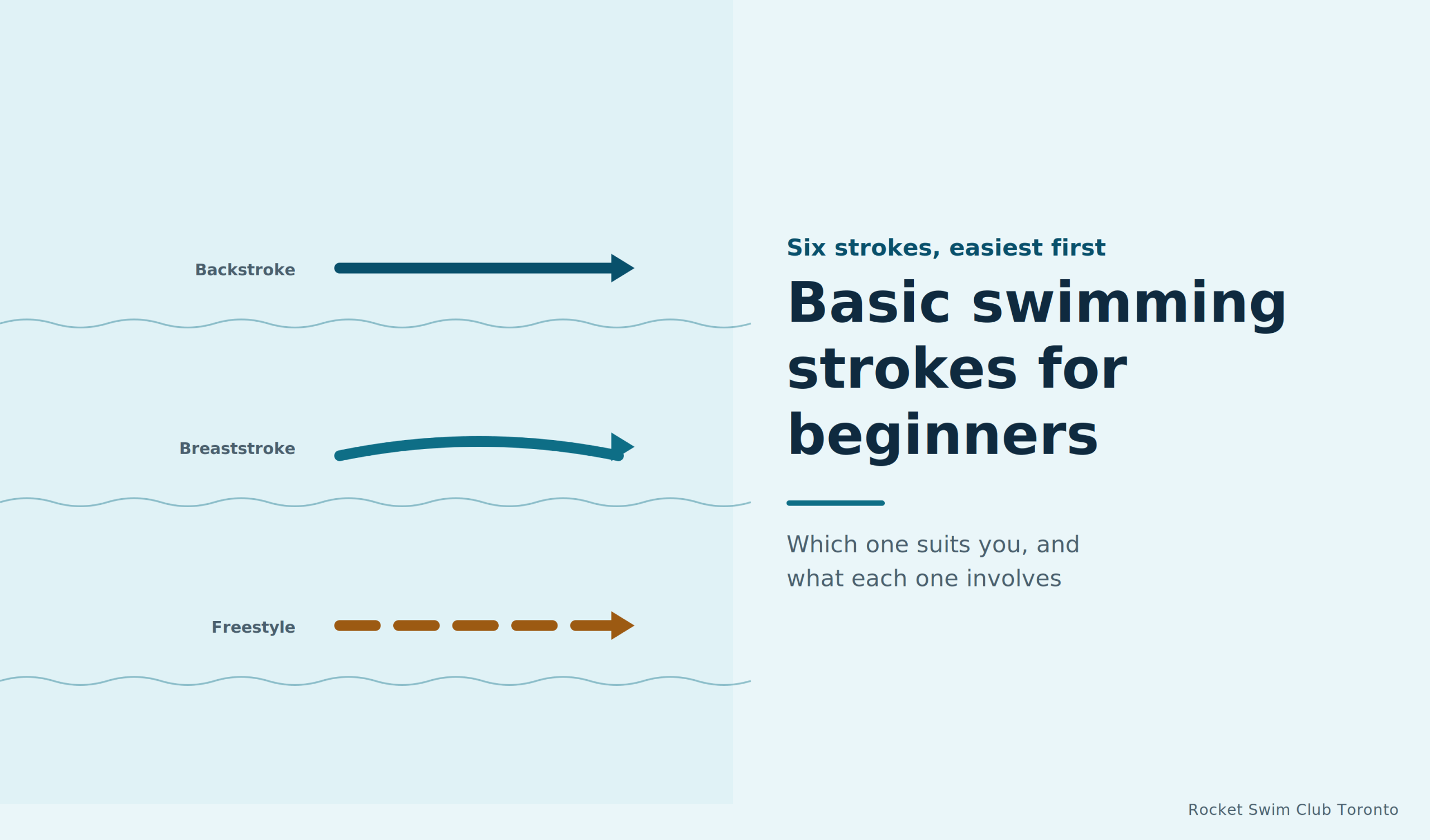
There are six strokes a recreational swimmer can reasonably learn, and nobody needs all six. This guide covers what every stroke has in common, then each of the six in turn starting with the easiest, then why a particular set of four gets grouped together, and finally what makes any stroke feel easier to swim. Rocket Swim Club teaches arm stroke technique as the fifth step of a six-step beginner sequence, after body position and kicking are settled.
Which swimming stroke should a beginner learn first?
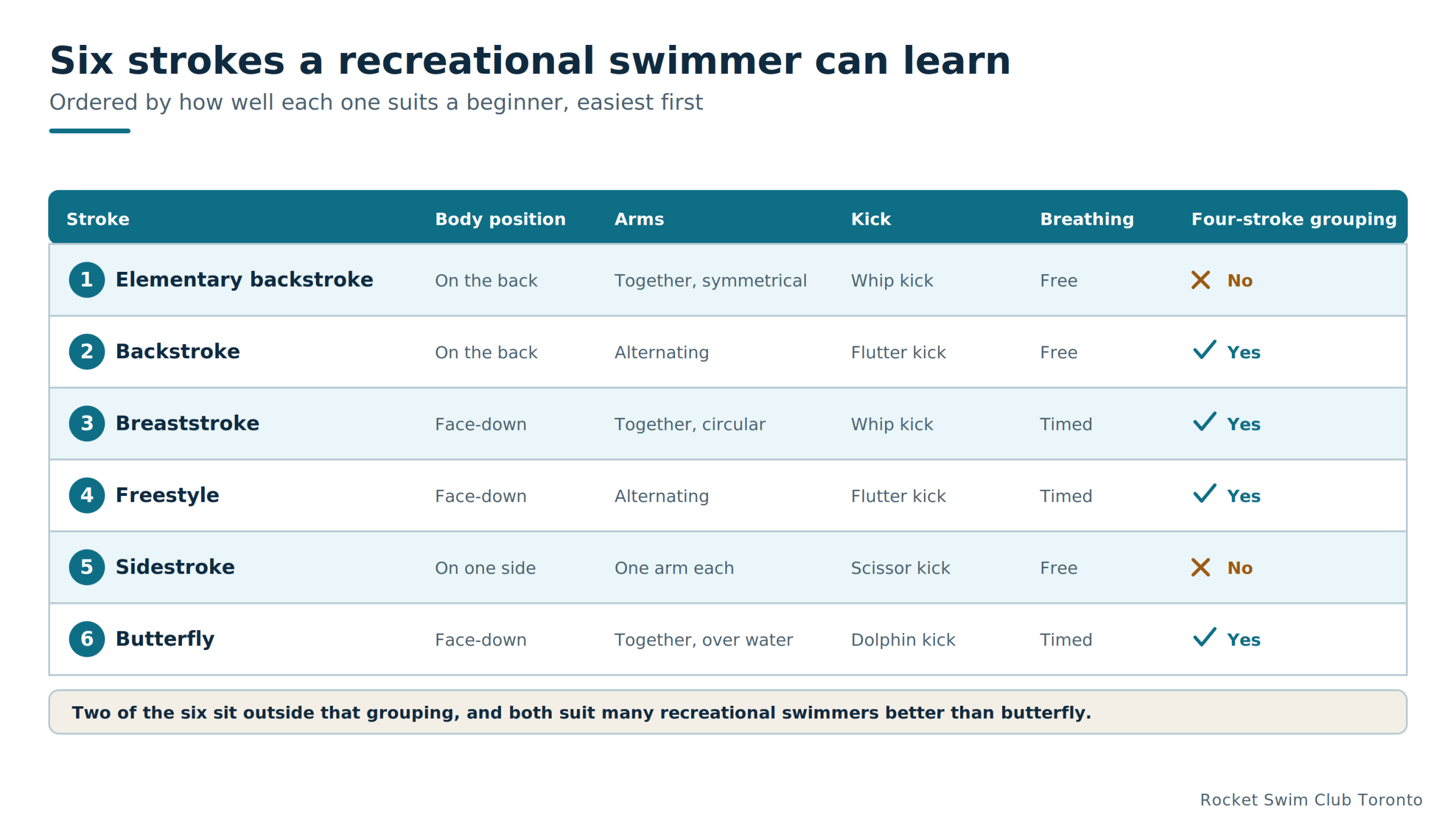
Most beginners learn elementary backstroke or backstroke first, because the face never goes into the water and breathing continues normally throughout. Strokes are easier to learn in the order of how much they interfere with breathing.
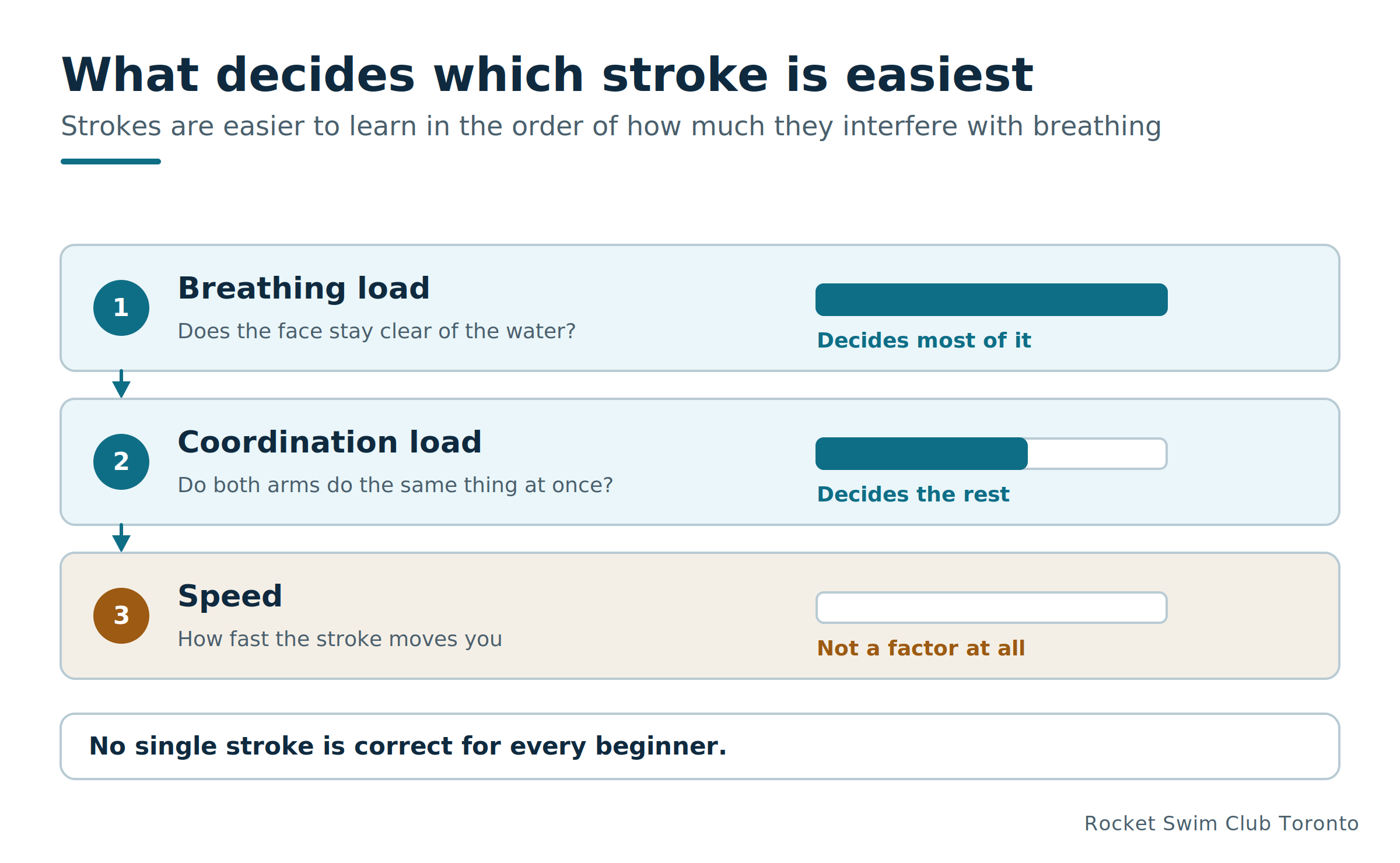
Coordination load comes second: a stroke where both arms do the same thing at the same time is simpler to hold together than one where they alternate. Speed is not a factor in the order at all. No single stroke is correct for every beginner, and a swimmer who finds their face in the water unbearable starts on their back.
What do all swimming strokes have in common?
Every swimming stroke combines four things: a body position, an arm action, a leg action and a breathing pattern. Those four are the template, and the six strokes below are described using it in the same order each time. Body position matters most of the four.
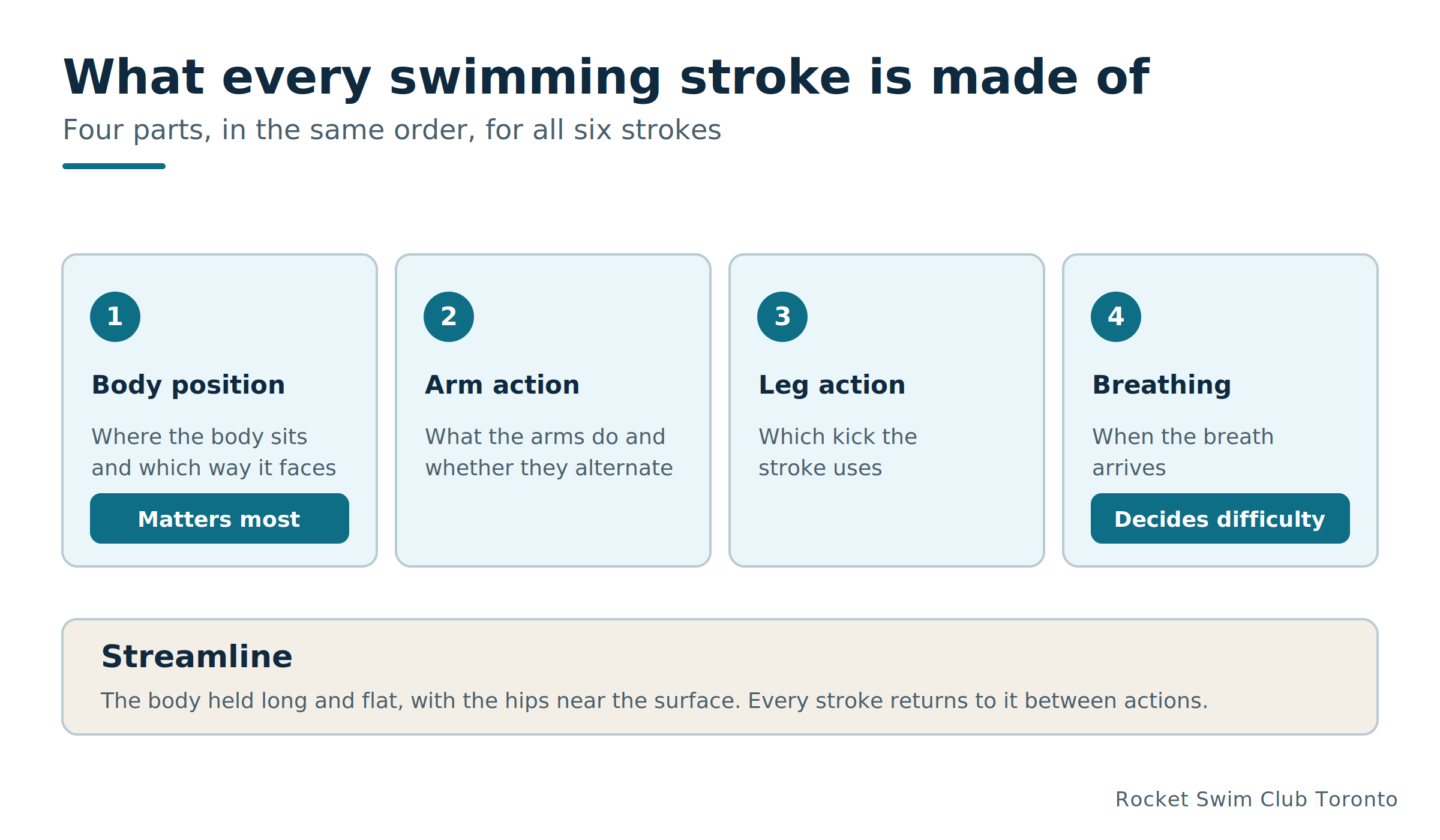
A body held flat near the surface travels forward; a body angled down drags water and stalls. That position is the one you learn in how to float in water, which is why floating is taught before any stroke rather than alongside them. Arm and leg actions supply propulsion, and the breathing pattern decides how much of a swimmer’s attention the stroke consumes.
What is streamline in swimming?
Streamline is the body held long and flat with the hips near the surface and the limbs in line with the direction of travel. A long body meets less resistance than a bent one, so the same effort carries a streamlined swimmer further. Every stroke returns to a version of streamline between actions. In breaststroke that return is a visible pause; in freestyle it happens for a fraction of a second as each arm extends.
Elementary backstroke
The elementary backstroke is a symmetrical stroke swum on the back, with both arms moving together and the face clear of the water the whole time.
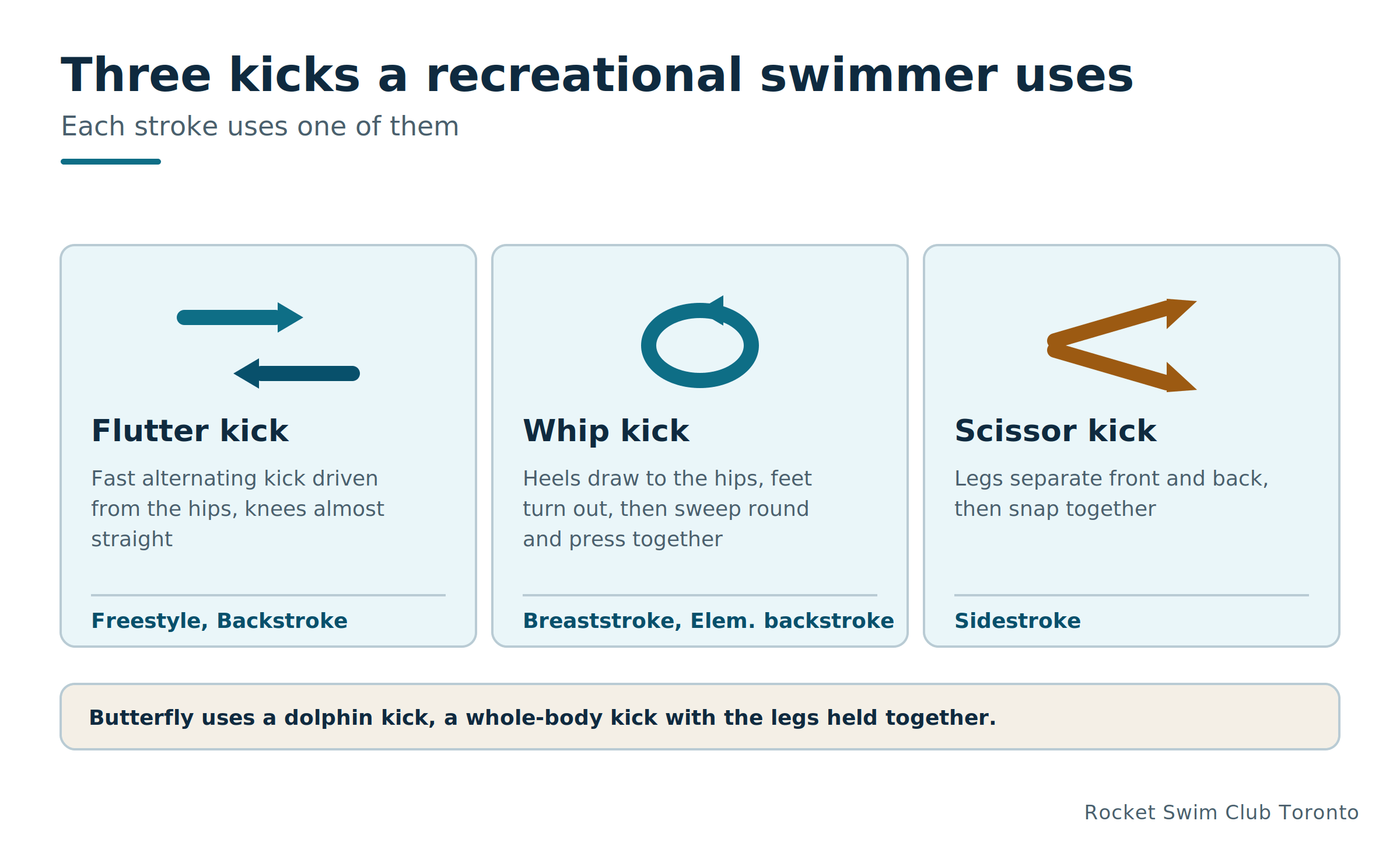
The body lies flat on the back at the surface. The arms draw up along the sides of the body to the shoulders, extend out to the sides, then push down to the hips. The legs perform a frog kick, which is a kick where the heels draw up toward the hips, the feet turn out, and both legs sweep round and press together. Breathing is unrestricted, because the mouth and nose never enter the water.
Elementary backstroke suits nervous adults and young children, and anyone who wants to move through water without managing a breathing pattern at the same time.
Backstroke
Backstroke is swum on the back with the arms alternating, one pulling through the water while the other recovers over it.
The body lies flat on the back with the hips near the surface and a slight roll toward each pulling arm. One arm lifts out of the water, passes overhead and enters above the shoulder; the other pulls down through the water at the same time. The legs perform a flutter kick, which is a fast alternating kick driven from the hips with the knees almost straight. Breathing is continuous.
Backstroke suits swimmers who are comfortable on their back and want to cover distance. The honest drawback is that a backstroke swimmer cannot see where they are going, so it needs a clear lane or an empty stretch of pool.
Breaststroke
Breaststroke is a face-down stroke built on a four-part rhythm: pull, breathe, kick, glide.
The body lies face-down and rises and falls with each cycle. Both arms sweep out and back together in a small circle in front of the chest. The legs perform a whip kick, also called a frog kick, the same action described in elementary backstroke.
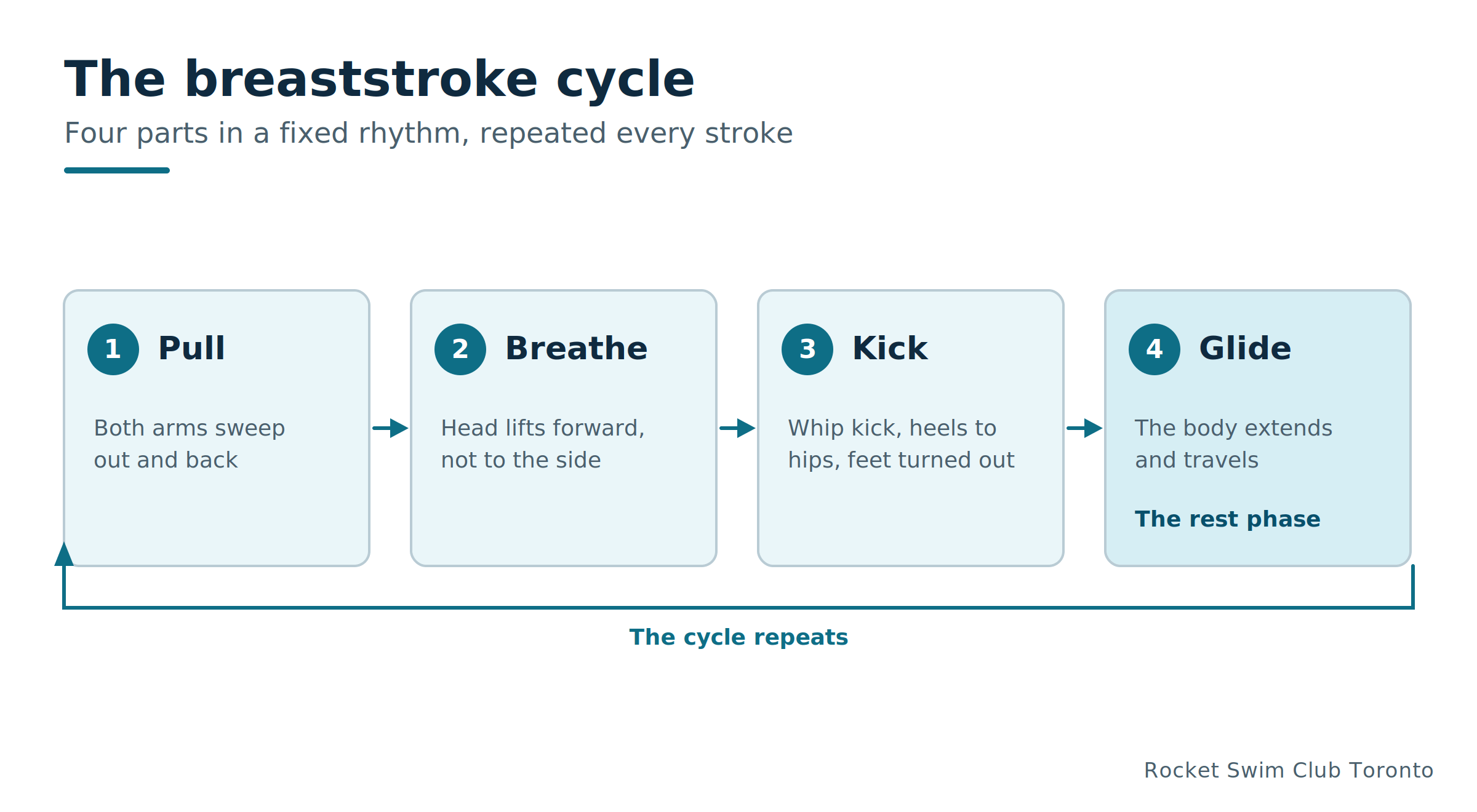
The head lifts forward to breathe at the end of the arm pull, not to the side, and returns to the water as the kick fires. The glide that follows is a rest phase, and it is the reason breaststroke is the least tiring stroke over distance for many swimmers.
Breaststroke is the slowest of the common strokes and the most controllable, which suits swimmers who want to swim at a conversational pace and stop easily.
Freestyle (front crawl)
Freestyle, also called front crawl, is a face-down stroke with alternating arms and a breath taken by turning the head to the side.
The body lies face-down and flat, rolling slightly toward each pulling arm. One arm pulls through the water beneath the body while the other recovers over the surface. The legs perform the flutter kick. The head turns to one side as the arm on that side recovers, and the mouth clears the water for a breath.
Freestyle is the stroke most Canadian learn-to-swim programmes teach first. That is a convention rather than a rule, and it is the hardest of the common strokes for a beginner to breathe in.
Why is breathing harder in freestyle?
Breathing is harder in freestyle because the face sits in the water and the breath has to be timed to a turn of the head. The swimmer exhales underwater through the whole stroke cycle and inhales during the brief window when the mouth is clear.
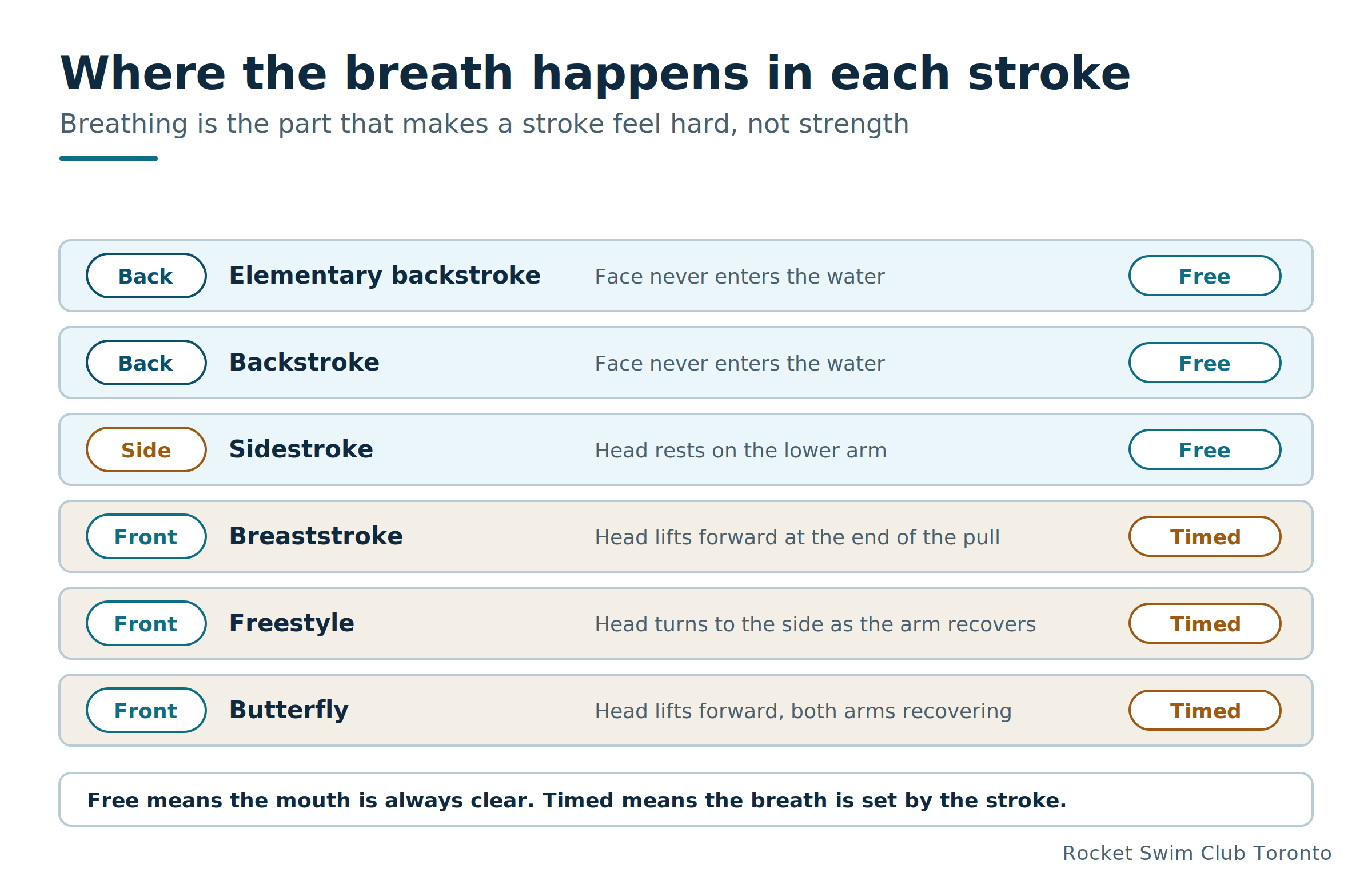
A breath taken late, or a head lifted rather than turned, drops the hips and stalls the stroke. This is a timing problem rather than a fitness problem, and it is covered in how to breathe while swimming. Two strokes remain, and neither belongs to the set most people have heard of.
Sidestroke
Sidestroke is swum lying on one side, with the head resting on the lower arm and the face clear of the water.
The body lies on its side at the surface. The lower arm extends ahead and pulls back to the chest; the upper arm pushes water back from chest to hip. The legs perform a scissor kick, where the legs separate front and back like the blades of a pair of scissors and then snap together. Breathing is unrestricted.
Sidestroke costs little effort over distance and leaves one arm free, which is why it is used in water rescue. For a recreational swimmer it is a comfortable way to cover a length while carrying on a conversation.
Butterfly stroke
Butterfly is a face-down stroke with both arms recovering over the water together and a dolphin kick, which is a whole-body kick with the legs held together.
It demands more shoulder mobility, more timing and more sustained effort than any other stroke. Most recreational swimmers never learn butterfly, and that costs them nothing. A swimmer who swims comfortably in one or two of the strokes above has everything recreational swimming requires.
Why are four strokes grouped together?
Freestyle, backstroke, breaststroke and butterfly are grouped and named together because that is how swimming is organised as a sport, and the grouping has carried over into general use. It describes a set of categories, not a learner’s syllabus. Two of the six strokes covered here, elementary backstroke and sidestroke, sit outside the grouping, and both are more useful to many recreational swimmers than butterfly will ever be. A recreational swimmer has no obligation to work through the set, and no stroke on it is a requirement for swimming well.
What makes a stroke feel easier?
A stroke feels easier when it costs less effort per length, and that is mostly a matter of position rather than power. Distance per stroke is how far you travel on a single arm pull, and it goes up when four things improve:
- Body position. Hips near the surface reduce drag more than any arm change does.
- Breathing pattern. A breath taken on time leaves the stroke undisturbed.
- Glide. Letting each stroke finish before starting the next covers distance for free.
- Relaxation. A tense swimmer fights the water and tires within a length or two.
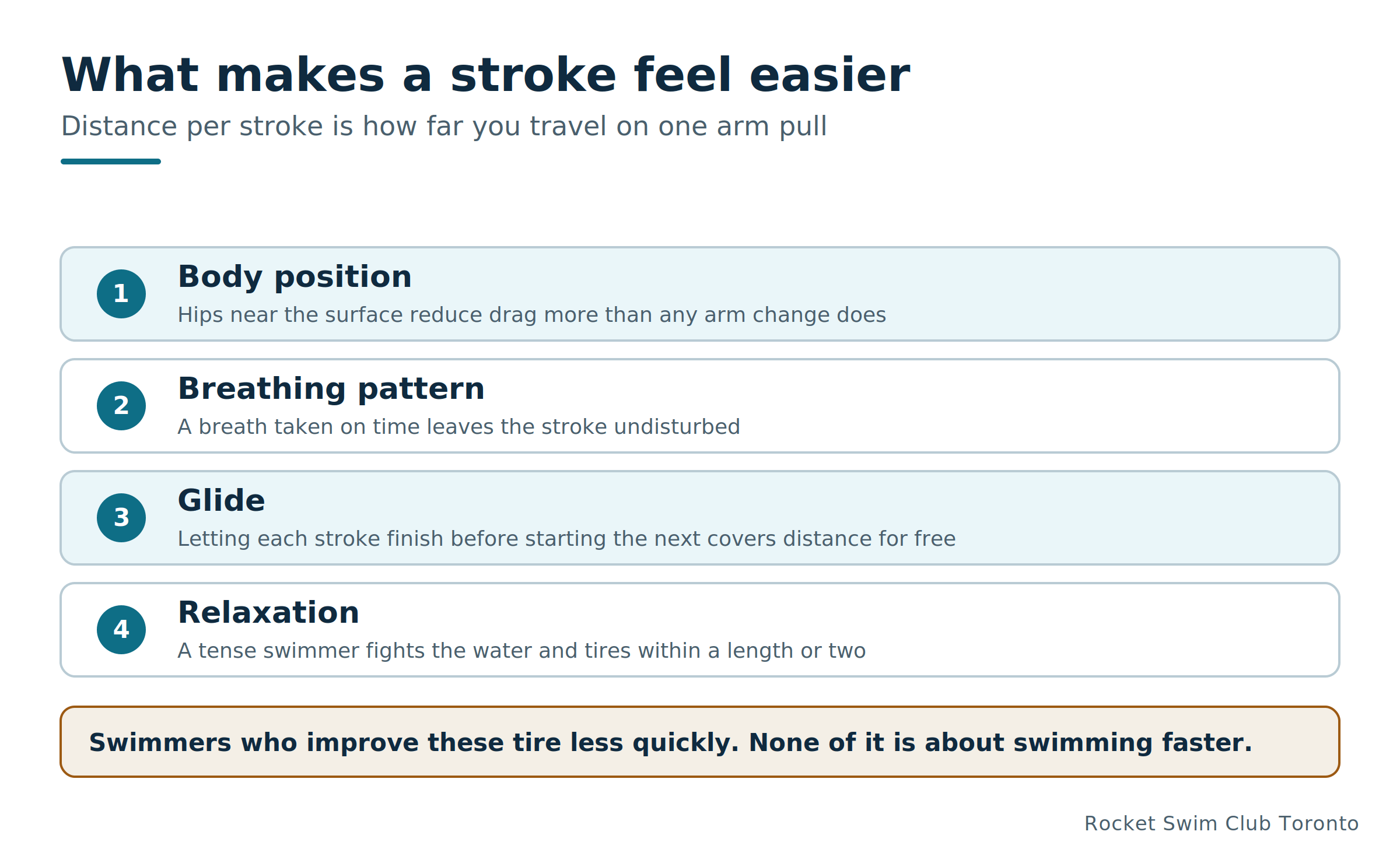
Swimmers who improve these tire less quickly and enjoy longer swims. None of it is about swimming faster.
Do you need more than one stroke?
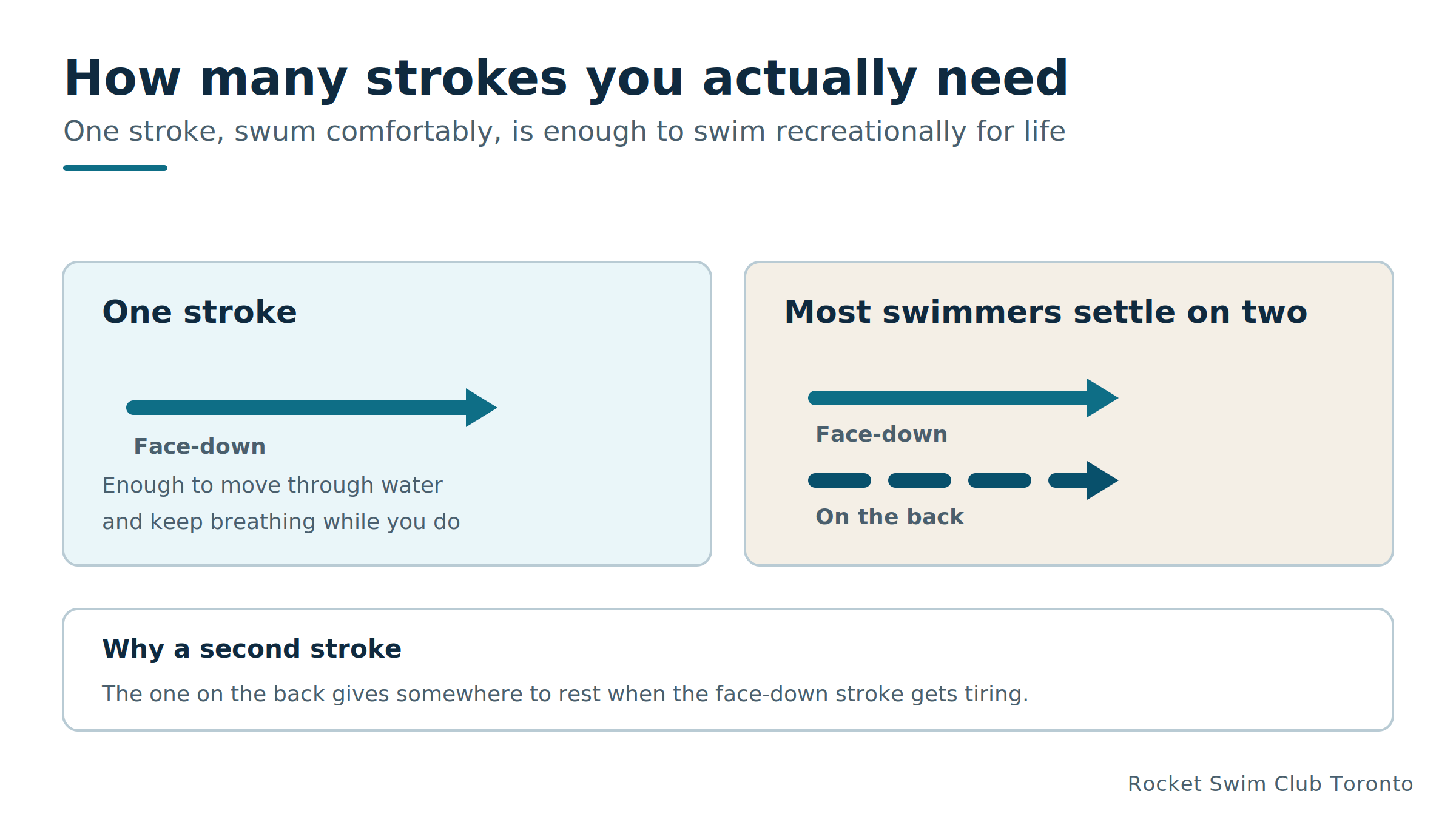
One stroke, swum comfortably, is enough to swim recreationally for life. Most swimmers end up with two, usually one face-down stroke and one on the back, because the second gives somewhere to rest when the first gets tiring.
Rocket Swim Club’s beginner sequence reaches arm stroke technique at step five of six, after comfort in the water, floating, breath control and kicking are settled, and its adult beginners typically swim a comfortable first length within 8 to 12 lessons. Where each stroke sits across the whole learn-to-swim path is set out in the Rocket Swim levels.
What a stroke guide cannot do
A written description tells you what a stroke looks like. It cannot tell you what yours looks like. Swimmers cannot see their own stroke, and the errors that cost the most effort … a dropped hip, a lifted head, a kick driven from the knee … feel normal from the inside. That is what stroke correction in a lesson is for: someone on the deck watching one length and naming one thing to change. Adults who taught themselves a stroke from reading usually arrive with a workable stroke and one habit costing them half their energy, which is the ordinary starting point for adult swimming lessons rather than a reason to avoid them.
Common questions about swimming strokes
Can you learn to swim with only one stroke?
You can swim with one stroke. Swimming means moving through water and breathing while you do it, and one comfortable stroke achieves that. Most swimmers add a second for variety and rest rather than necessity.
Is breaststroke easier than freestyle?
Breaststroke is easier than freestyle for most beginners, because the head lifts straight forward to breathe instead of turning to the side, and because the glide gives a rest inside every cycle. Breaststroke asks more of the legs, so swimmers with restricted knee or hip movement often find freestyle easier instead.
Do you have to learn butterfly?
No. Butterfly is not required for recreational swimming, and most recreational swimmers never learn it.
Can an adult learn a new stroke from scratch?
Adults learn new strokes routinely, and an adult who already swims one stroke has the body position and breath control that the next one needs. Starting points are set by a short in-water assessment ($17, 10 to 15 minutes) at recreational swimming lessons in Toronto, which places a swimmer in a small group at an indoor pool in the west end of the city.