
You can learn to swim at any age, from no ability at all. Adult lessons are coached sessions grouped by what you can currently do in the water rather than by how old you are, which is why a 27-year-old and a 68-year-old routinely end up in the same group.
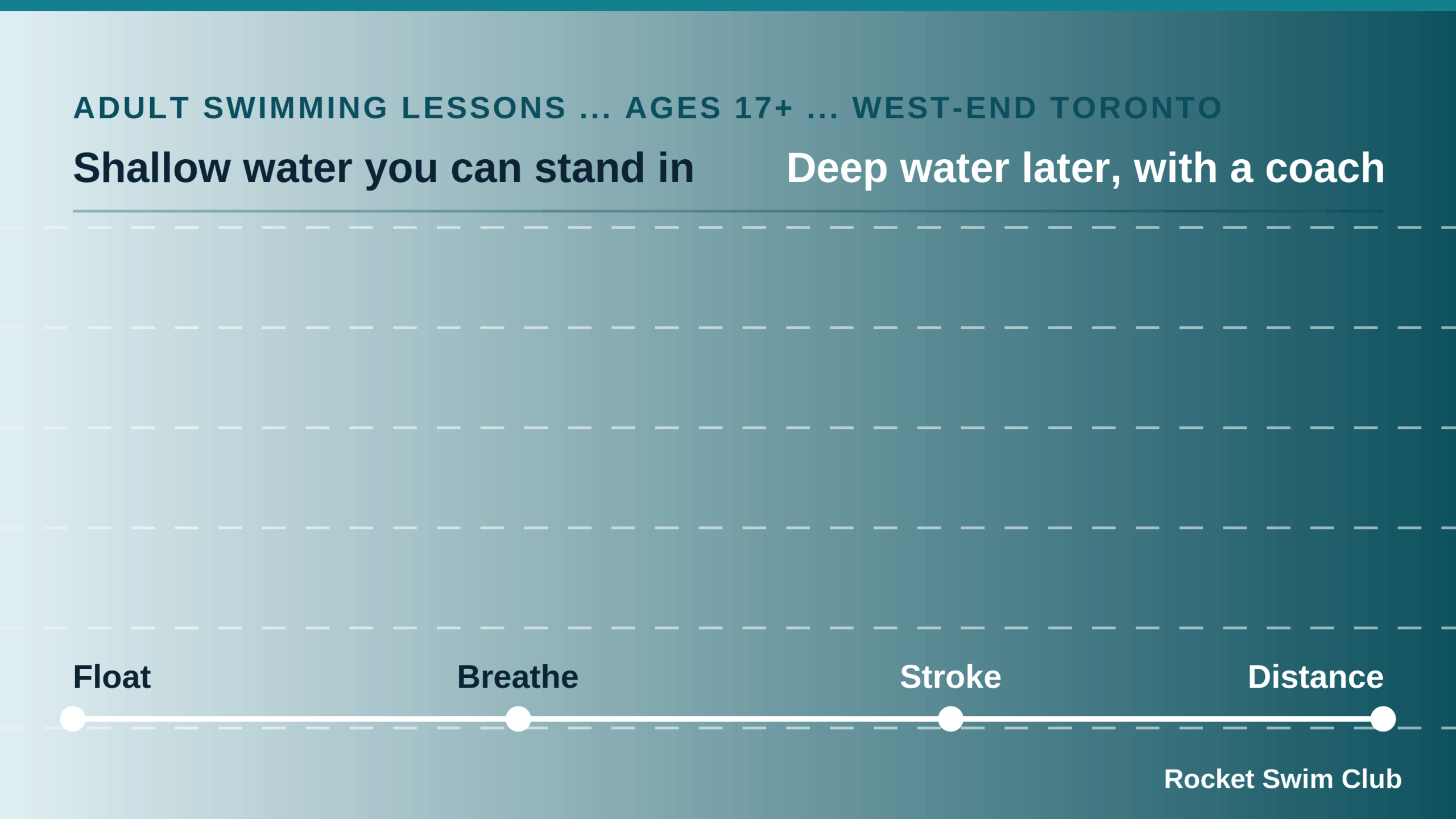
Rocket Swim’s adult swimming program runs from age 17, in three groups, and a coach places you after a short assessment in the water.
What follows covers who these lessons suit, what happens if you cannot swim a stroke today, what the curriculum contains, why water is a manageable place for an adult body to start moving again, and how a coach decides which group you join.
Book an assessment. It costs $17 and runs 10 to 15 minutes.
What are adult swimming lessons?
Adult swimming lessons are coached sessions grouped by ability rather than by age. You swim with people working on the same skill you are, whatever decade they or you happen to be in.
That grouping is the whole design. An adult who cannot float and an adult building a 1,000 metre set have nothing useful to do in the same lane, and neither has anything to do with the other’s age. The program sorts on the only variable that changes what a coach can teach you in the next hour.
Who are adult swimming lessons for?
Adults arrive from three starting points, and the adult program runs a group for each.
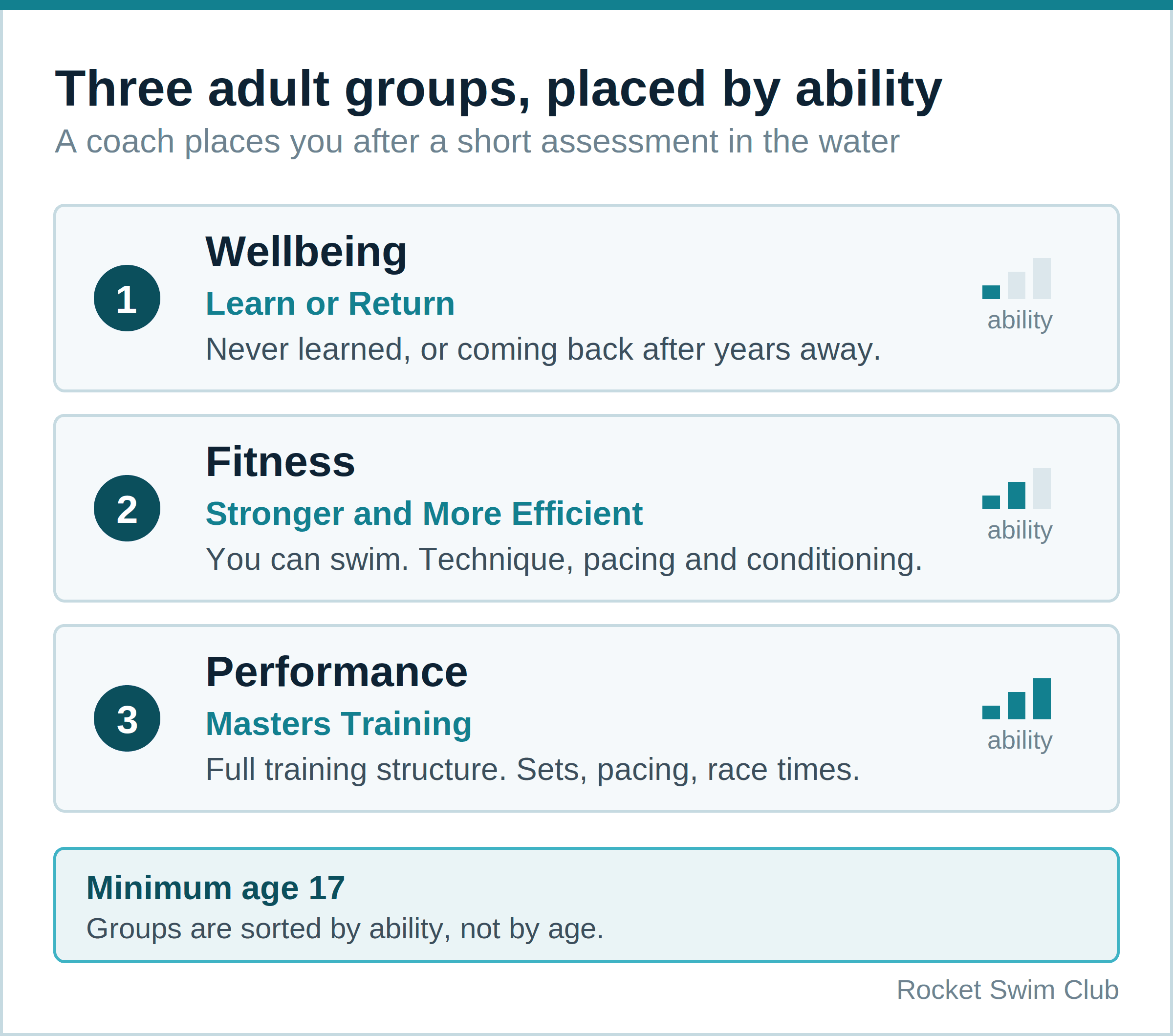
Learn or Return (Wellbeing)
For adults who never learned, and for adults coming back after a long time away.
Plenty of people reach forty, fifty or seventy without ever having been taught. Lessons were not available, the family did not swim, a bad experience ended it early, or it never came up. That is an ordinary place to begin rather than a gap you need to explain.
Returning swimmers land here too. You learned as a child, you have not swum since your twenties, and you are not sure what is left. Usually more than you expect and less than you would like. Body position tends to survive. Breathing and endurance do not, so returning swimmers often spend a few sessions rebuilding a breathing pattern before anything else makes sense.
Wellbeing works at whatever pace the swimmer needs: water confidence, core skills relearned, comfort ahead of speed, in a room full of other adults doing the same thing.
Stronger and More Efficient (Fitness)
For adults who can swim and want the stroke to hold up.
You get from one end to the other, but it falls apart after four lengths and nobody has ever told you what to fix. Fitness works on technique, cardiovascular conditioning, pacing and consistency rather than on new skills. Most swimmers here come for the training effect rather than the swimming itself.
Masters Training (Performance)
For adults who want a full training structure.
Sets, pacing and technique work at a level that will move your times, whether the target is a personal best, an open-water swim, or a Masters meet. The club runs a performance pathway pointing at the World Masters Championships in Budapest in 2027. Plenty of Performance swimmers never enter a meet at all and treat it as the best-coached hour in their week. Both are normal.
Find your adult group if you already know roughly where you sit.
The first group carries the biggest question, so it goes first.
Can you start if you cannot swim at all?
Yes. Adult lessons at Rocket Swim start from no swimming ability, in water you can stand up in.
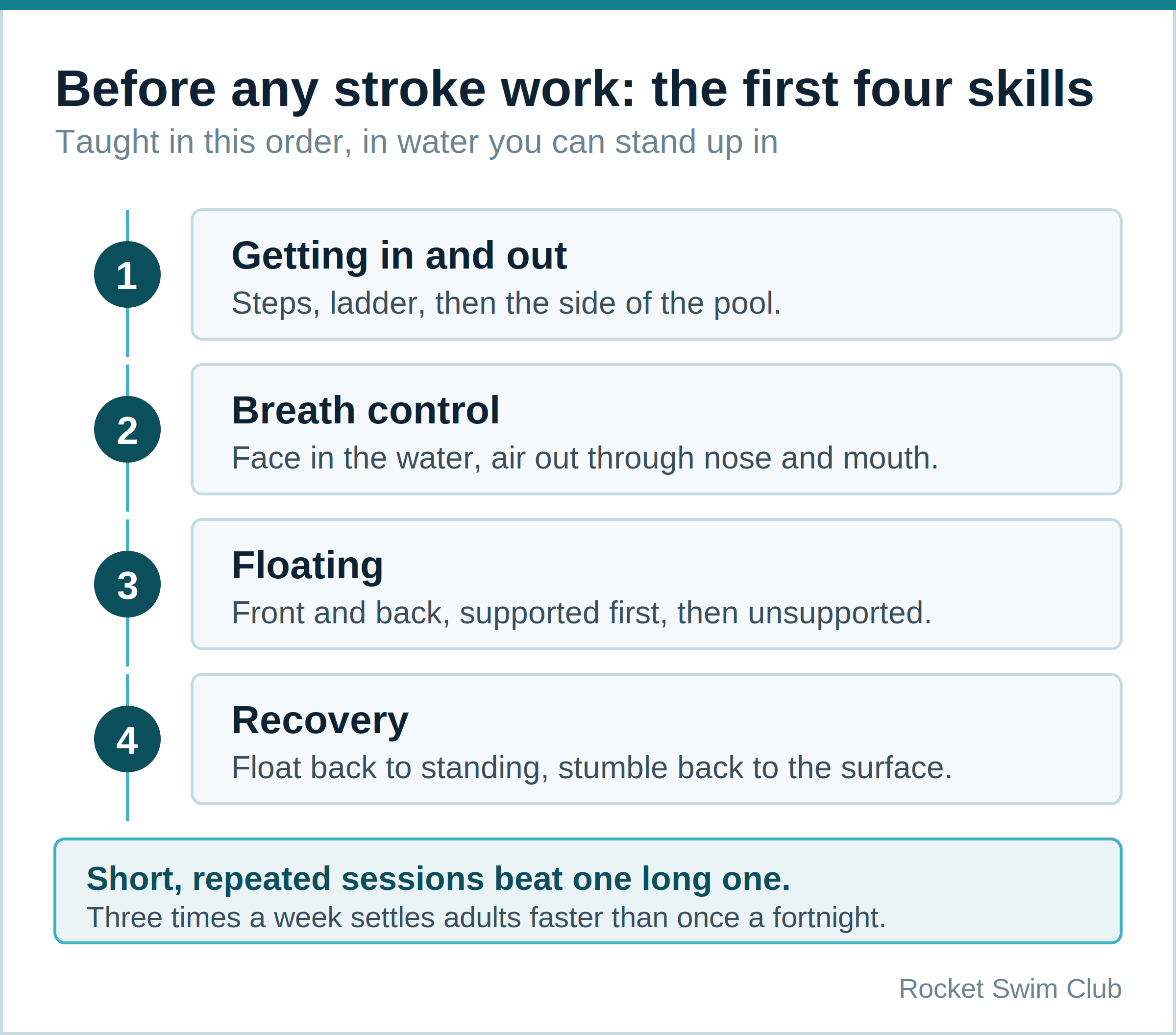
The first sessions are not stroke sessions. They cover four things, in this order:
- Getting in and out of the water comfortably. Steps, ladder, and eventually the side of the pool.
- Breath control. Face in the water, air out through the nose and mouth, head up. Exhaling underwater instead of holding your breath settles most adults, and it is usually the first thing that clicks.
- Front and back, supported by the coach first and then unsupported. The work here is not effort. It is learning that your body sits at the surface once it stops bracing.
- Getting from a float back to standing, and from a stumble back to the surface. This is the skill that makes the rest of the pool feel manageable.
Water confidence builds through short, repeated exposure in shallow water rather than one long session in the deep end. Frequency matters more than duration at this stage. Adults who swim three times a week settle faster than adults who come once a fortnight, because comfort in water fades between sessions in a way that most skills do not.
Once breathing and floating happen without thinking, stroke work starts.
What do adult swimming lessons cover?
Adult lessons cover the same technical ground as any swimming program: breath control, floating, four strokes, treading water, deep-water comfort, turns, and building distance.
- Flutter kick, long arm recovery, breathing to the side. Bilateral breathing comes once the stroke holds together.
- The same kick with an opposite arm cycle and no breathing restriction, which is why it often comes together first for adults.
- Whip kick and a timed glide. Adults tend to like this one, because you take the breath at the front of the stroke and the rhythm is unhurried.
- Dolphin kick and a simultaneous recovery. Optional for most adult swimmers, taught last where it is wanted.
- Distance and turns. Building from a single 25 metre length to continuous sets, with turns that let you keep going instead of stopping at each end.
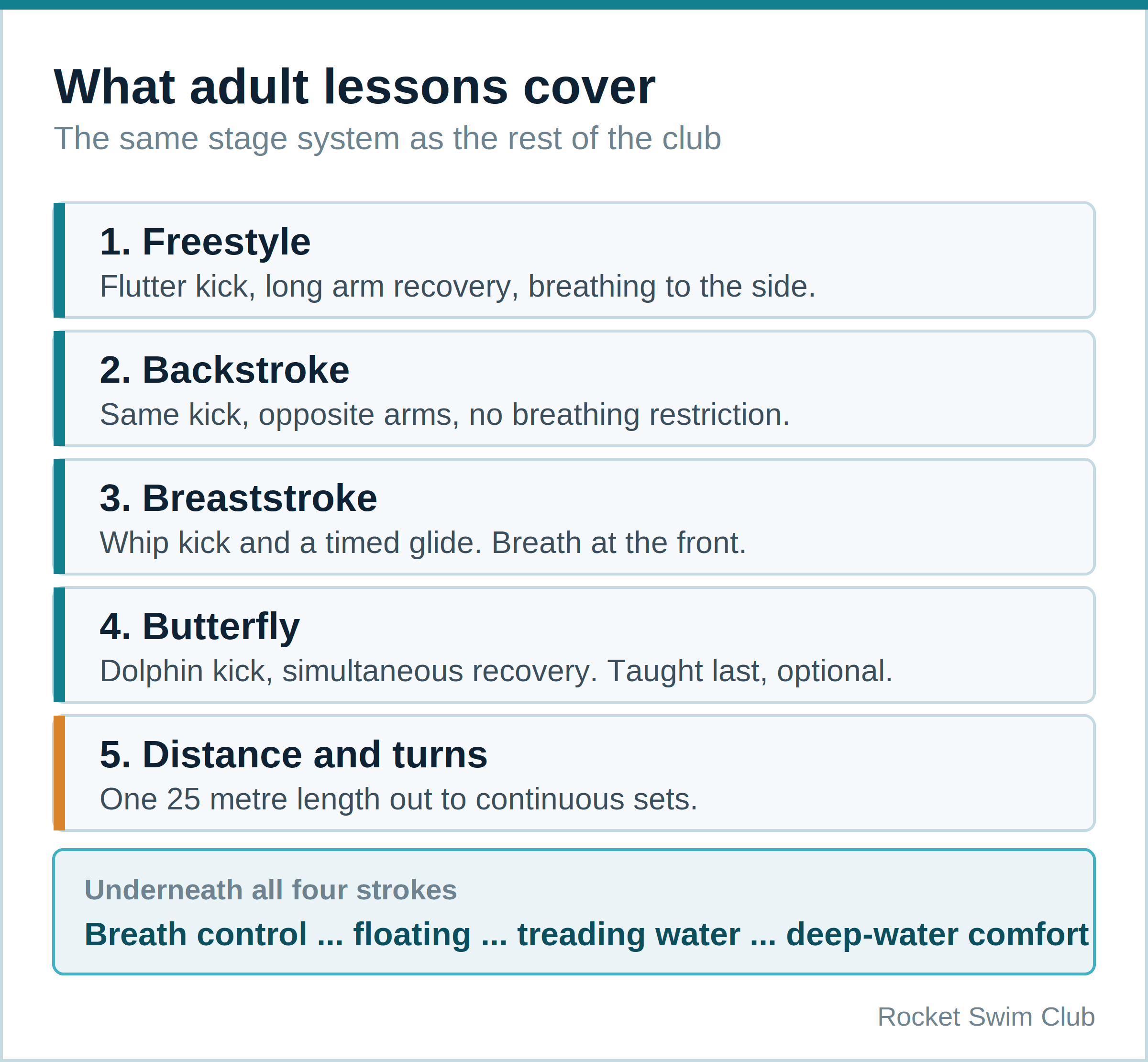
Adults work through the same stage system as the rest of the club, which is why an adult group and a youth group can share a curriculum without sharing a lane.
What is Masters swimming?
Masters is the international category for adult swimming, and the whole Rocket Swim adult program sits under it, from Novice through to Masters. Being a Masters swimmer says nothing about how fast you are. It means you are an adult swimming with a coach.
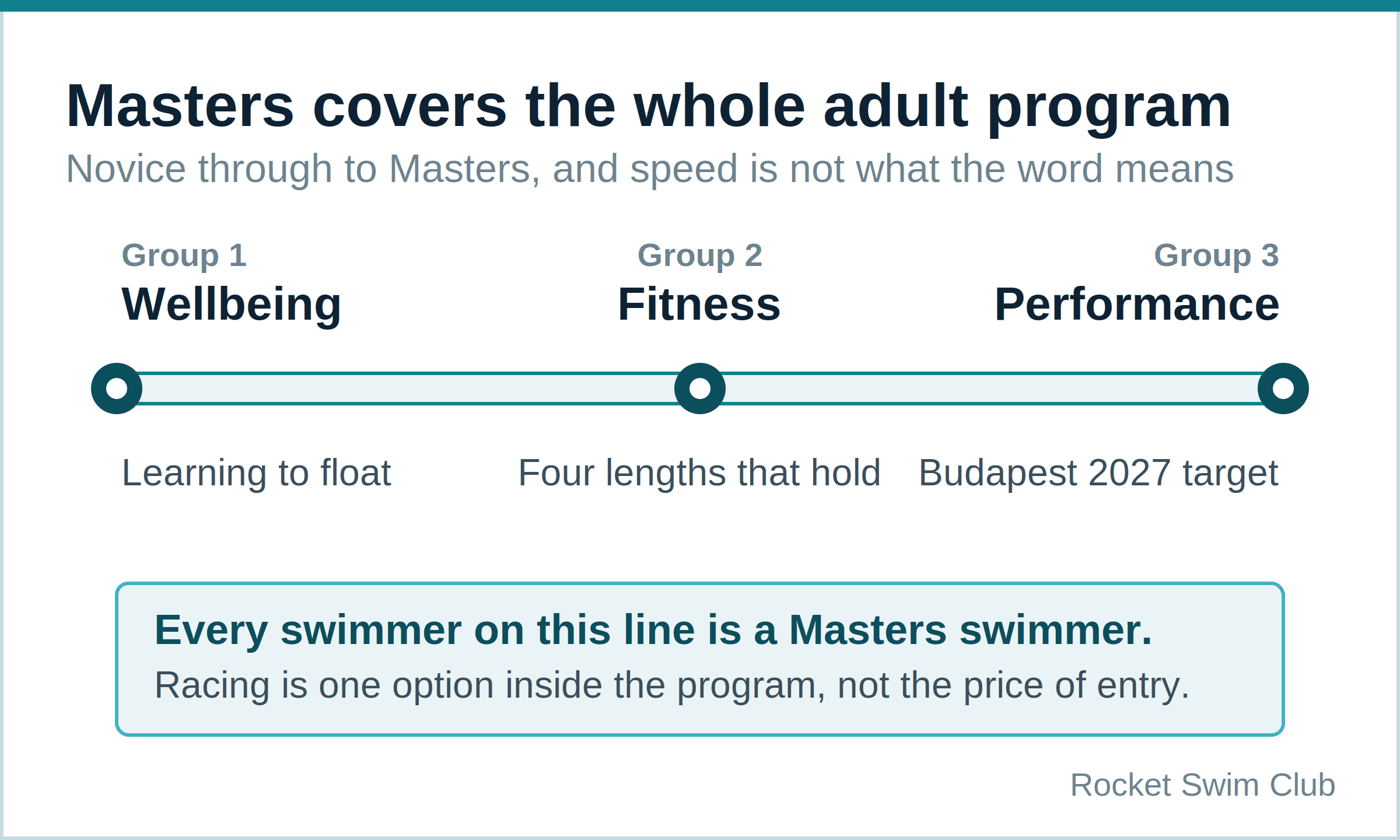
That is worth spelling out, because the word puts off people who would enjoy it. A Wellbeing swimmer learning to float and a Performance swimmer training for Budapest are both Masters swimmers. Racing is one option inside the program rather than the price of entry.
Who coaches adult lessons?
Every Rocket Swim coach holds National Lifeguard (NL) certification and a minimum of NCCP Swimming 101 through the National Coaching Certification Program. Most bring competitive swimming backgrounds and years of coaching behind that.
For an adult who is nervous in water, the lifeguarding certification is the part that matters. The person teaching you is trained and current in water rescue, not only in instruction.
Why does water suit an adult body?
Water carries most of your body weight, so the load going through your knees, hips and ankles while you swim is a fraction of what running or a court sport puts through them. That is the practical reason swimming works for an adult who has been out of regular exercise for years, or who is carrying stiffness that makes land training unappealing.
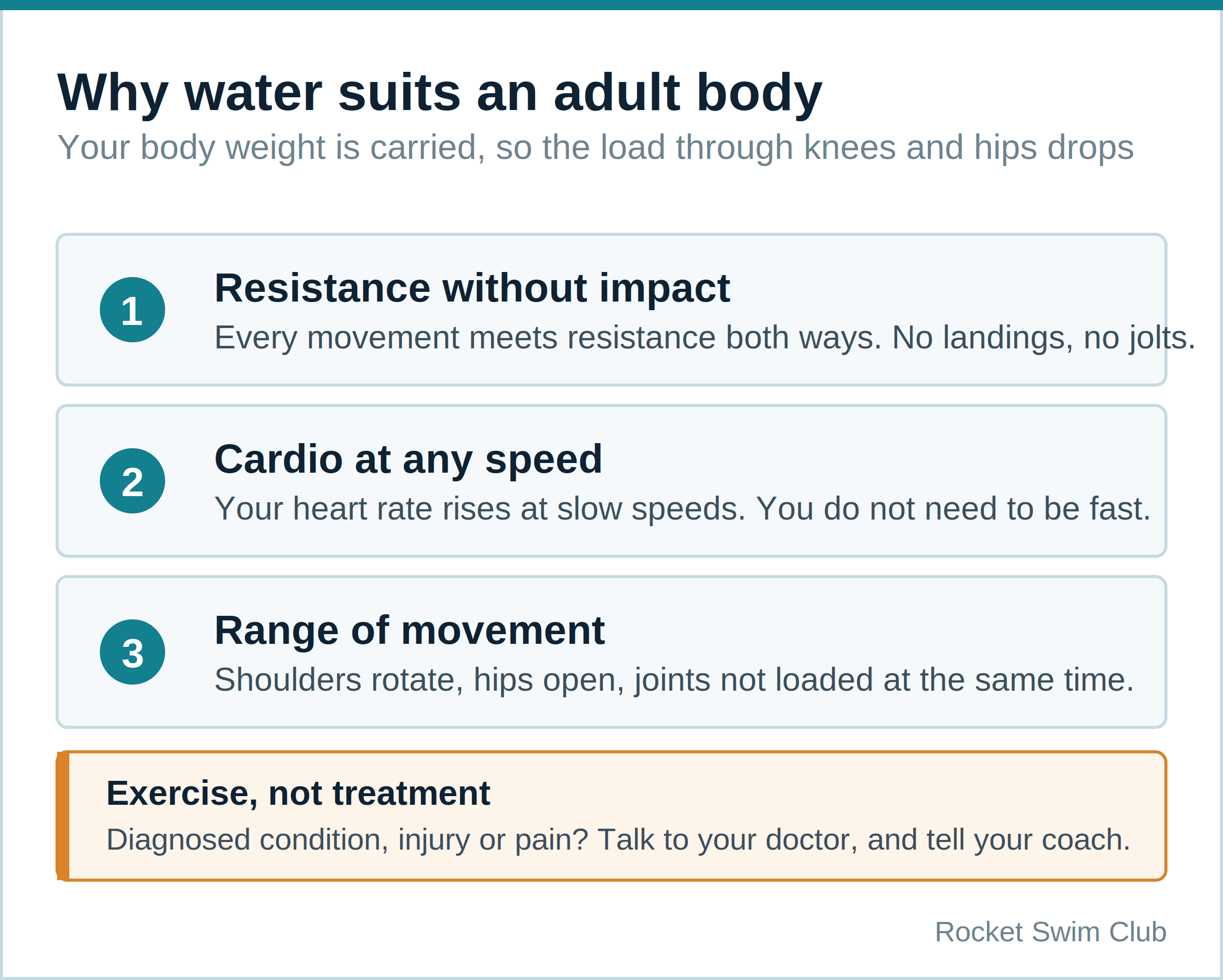
Three things follow from buoyancy:
Resistance without impact. Water is dense, so every movement meets resistance in both directions. You get muscular work across the whole body without a single landing or jolt.
Cardiovascular work at whatever speed you can manage. Swimming raises your heart rate at slow speeds, which matters if you are deconditioned. You do not need to be fast to be working.
Range of movement. Front crawl and back crawl take the shoulders through a full rotation, and breaststroke opens the hips, in a supported environment where the joint is not loaded at the same time. Adults who sit at a desk all week tend to notice this before they notice fitness.
Swimming is exercise rather than treatment. If you have a diagnosed condition, an injury or persistent pain, talk to your doctor about what is appropriate before you enrol, and tell your coach what you are working around so sessions can be adjusted.
Where are adult lessons held in Toronto?
Rocket Swim runs sessions at four west-end pools, covering High Park, Swansea, Bloor West Village, Runnymede and the Eglinton West area.
| Pool | Address | Area |
| Western Technical-Commercial School | 125 Evelyn Crescent | High Park North |
| Swansea Community Recreation Centre | 15 Waller Avenue | Swansea |
| Runnymede Collegiate Institute | 569 Jane Street | Runnymede |
| York Memorial Collegiate Institute | 1700 Keele Street | Keelesdale / Eglinton West |
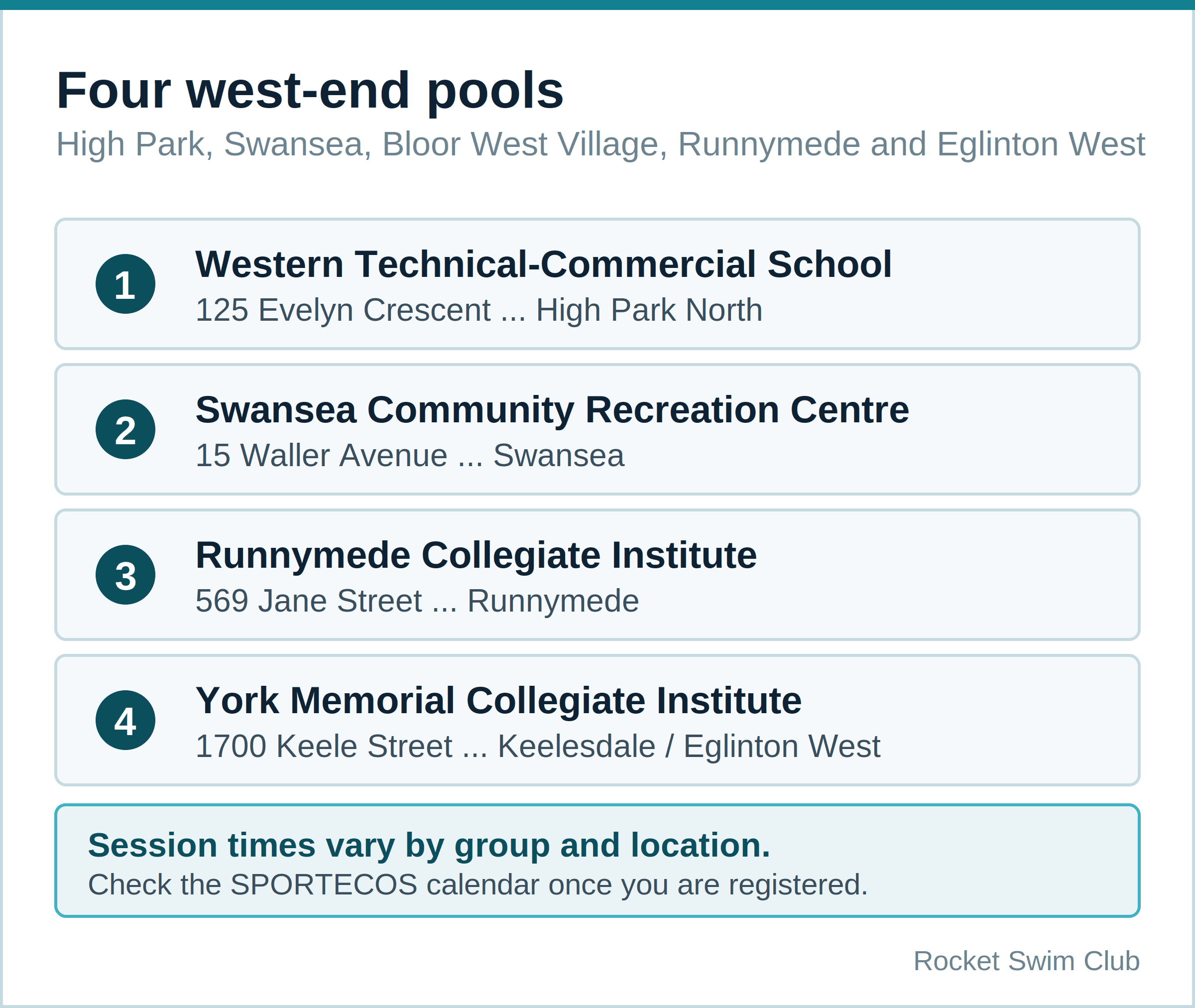
Adult session times vary by group and location, so check the SPORTECOS calendar once you are registered. Full details sit on the contact and locations page.
How do adults get started at Rocket Swim?
You book a short assessment, a coach suggests your group, then you enroll.
- Book the assessment. It costs $17 and runs 10 to 15 minutes in the water. You read and accept the waiver of liability online as part of booking, so there is nothing to sign on the day and nothing sprung on you at the pool.
- The club confirms your day and time. If you have not heard back within a week, email info@rocketswim.com and we will sort it.
- Bring a swimsuit, goggles, swim cap and towel. That is the whole list.
- Answer a few questions on deck. Coaches ask how long you have been swimming, whether you have been on a swim team, whether you know the strokes, and what you want out of it. If the honest answers are never, no, none, and I want to be able to swim, that is a complete and useful answer. It puts you in a group that starts where you actually are.
- Receive your placement. A confirmation email tells you your group.
- Check the schedule, sign the forms and pay through SPORTECOS, which handles club registration and payments.
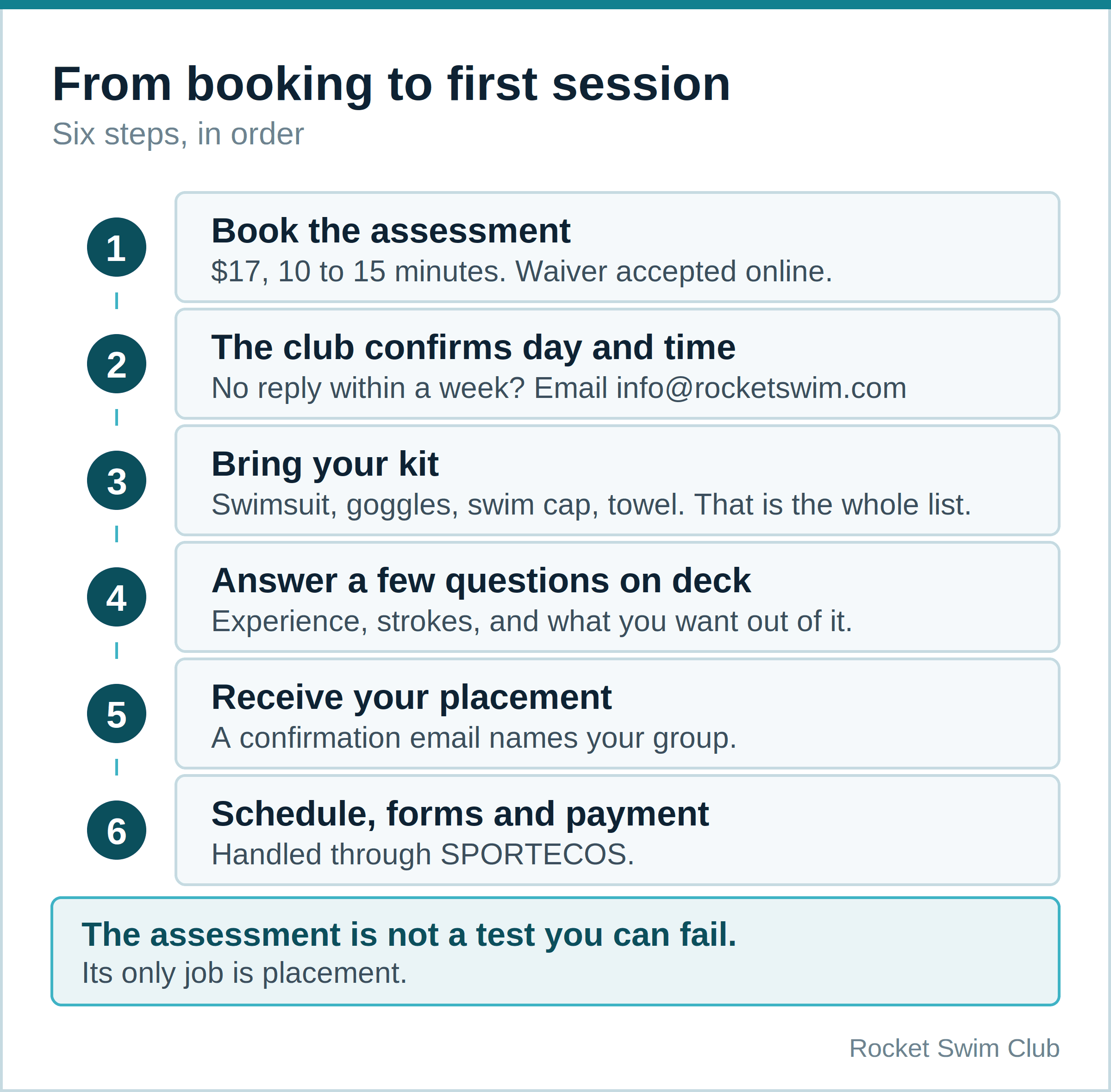
The assessment is not a test you can fail. Group assignment gets suggested after the tryout, which means its only job is placement.
Start here, or get in touch if you would rather ask a question first.
What do adult swimming lessons cost?
Lessons run in three-month terms, and one registration covers a full term of weekly sessions. Adult and Masters lessons start at $572 per term.
The assessment costs $17, paid once, and covers the coach’s time to assess and place you.
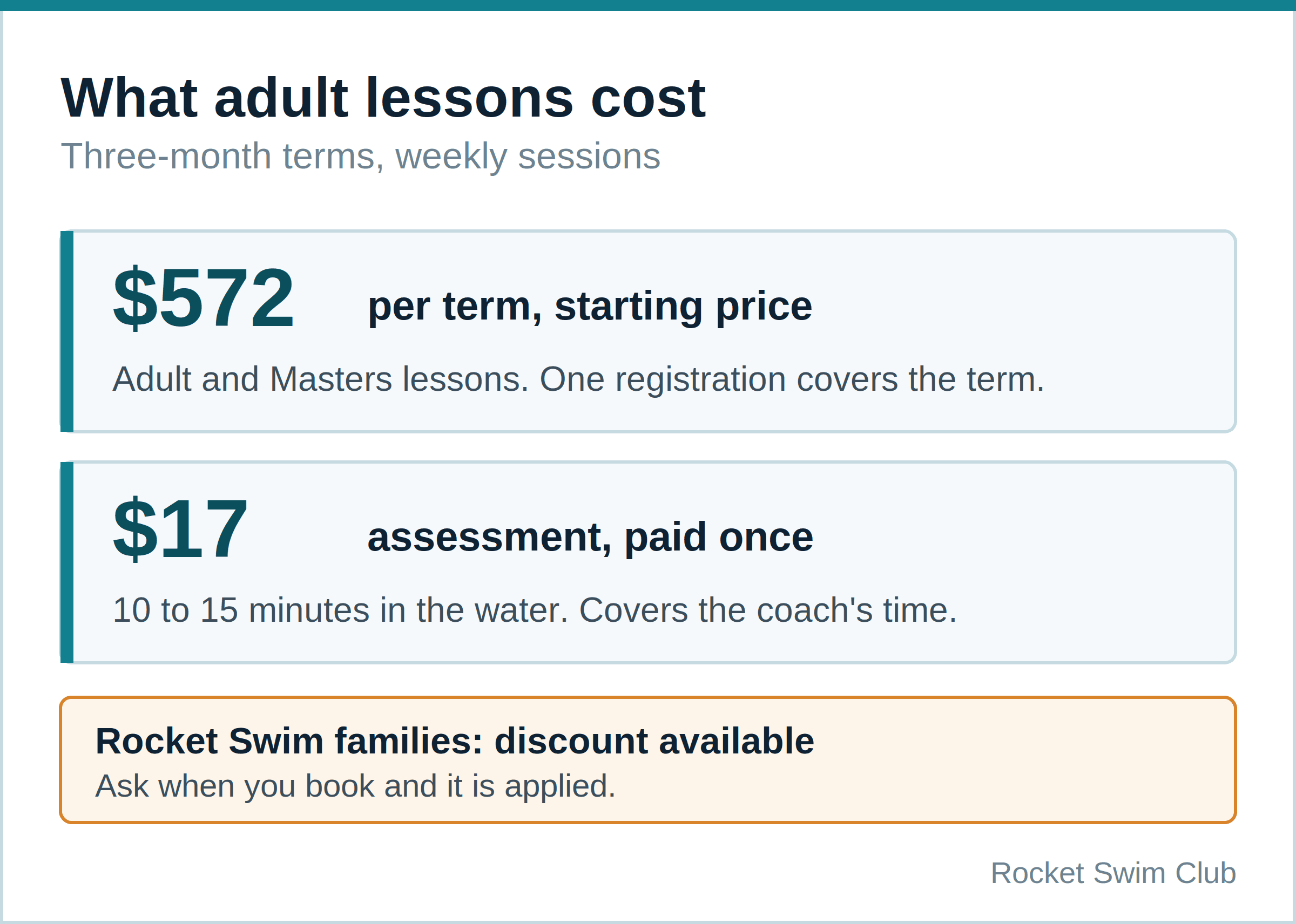
Rocket Swim families qualify for a discount on the adult program. Ask when you book and we will apply it.
Full group options and current schedules sit on the adult program page.
What adult lessons are not
Adult lessons are not a fitness test, not a deep-water test, and not something you need to prepare for. There is no baseline to meet before you book, no length you are expected to swim on arrival, and nothing to practice in advance. The three things adults most often assume they need to sort out first are all things the lessons themselves are for.
Do you need to be fit before you start?
No. You do not need any level of land fitness to begin. The early sessions involve standing, floating and short movements in shallow water, none of which need aerobic capacity or strength. Fitness comes out of swimming regularly rather than being a requirement for starting. Adults who try to get fit on land first usually just delay the start by several months.
Do adult lessons use the deep end?
Not at the beginning. Beginner sessions run in water shallow enough to stand in, and deep water arrives only once floating, recovery and treading are reliable. When it does happen, it happens deliberately, with a coach nearby. Nobody gets moved into deep water to see what happens.
What do you need to bring?
A swimsuit, goggles, swim cap and towel, every session. The club requires club-approved equipment in practices, so buy against its equipment list rather than guessing. Members get 20% off at Splashables in Toronto, and Team Aquatic Supplies in Mississauga and Burlington stocks the same range.
Can you swim while your child has their lesson?
Yes. Rocket Swim schedules adult slots that run at the same time as children’s groups, so a parent can be in the water rather than on the bench, and the club discounts the adult program when you do. For a household already committed to a weekly drive to the pool, it removes the scheduling problem that stops most parents taking lessons themselves.
What is the minimum age for adult lessons?
Swimmers younger than that join through the non-competitive program or the competitive program