

Floating is holding a still position at the surface of the water using buoyancy rather than movement. It is the first in-water skill most beginners learn, and it is learnable at any age.
Three things decide whether a float works:
- How buoyant your body is,
- Where your head and hips sit, and
- How relaxed your muscles are.
The rest of this guide covers what floating actually is, how to hold a back float and a front float, why legs sink and what to do about it, how to stand up again, and the conditions a beginner should be practising in.
Floating is also where recreational swimming lessons start, because a swimmer who can rest at the surface has a place to go when a stroke stops working.
What is floating in water?
Floating is staying at the surface of the water with minimal movement. The water supports the body’s weight, so no kicking or pulling is needed to hold the position. That is the difference between floating and swimming: swimming moves you somewhere, floating keeps you where you are. A float can be held on the back, on the front, or in a tucked position, and each one uses the same underlying force.
Why does the human body float?
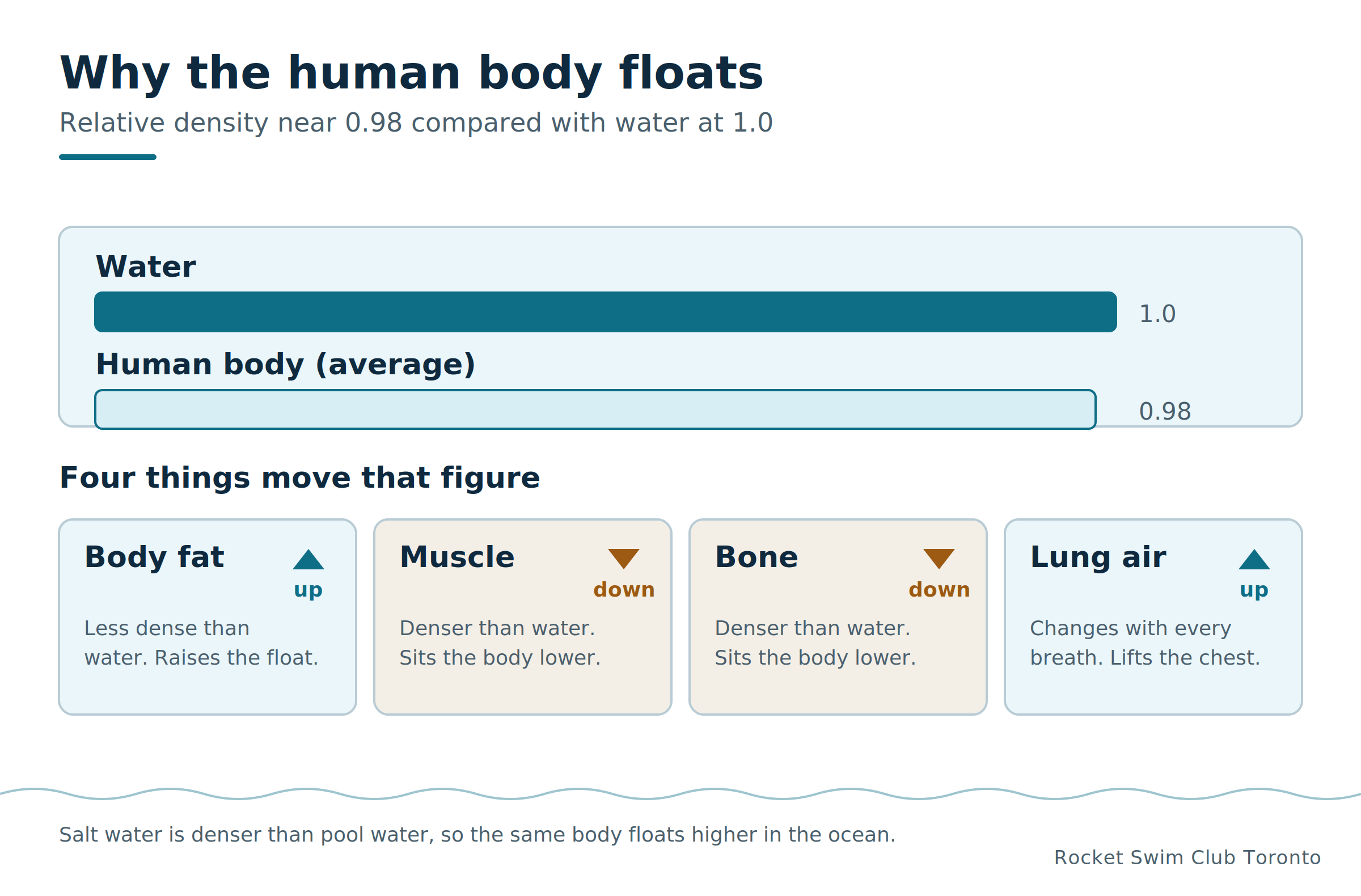
The human body floats because it is slightly less dense than water. Average relative density of the body sits near 0.98 compared with water at 1.0, which is why most people sit at the surface rather than sinking to the bottom. That figure is an average, and four things move it: body fat, which is less dense than water; muscle and bone, which are denser; and the volume of air in the lungs, which changes with every breath. Salt water is denser than pool water, so the same body floats higher in the ocean than in an indoor pool.
Buoyancy is the upward force the displaced water applies to the body, and it is the force every float depends on.
How do you float on your back?
The back float is the position most beginners learn first, because the face stays clear of the water and breathing continues normally throughout. Practice it in shallow water where you can stand with your head clear, with another person beside you.
- Stand in chest-deep water with your back to the open pool.
- Lower your shoulders under the surface and take a full, slow breath.
- Tilt your head back until your ears are underwater and your eyes look straight up.
- Lean back and let your hips rise toward the surface.
- Spread your arms and legs wide.
- Breathe slowly and steadily, and let the water hold you.
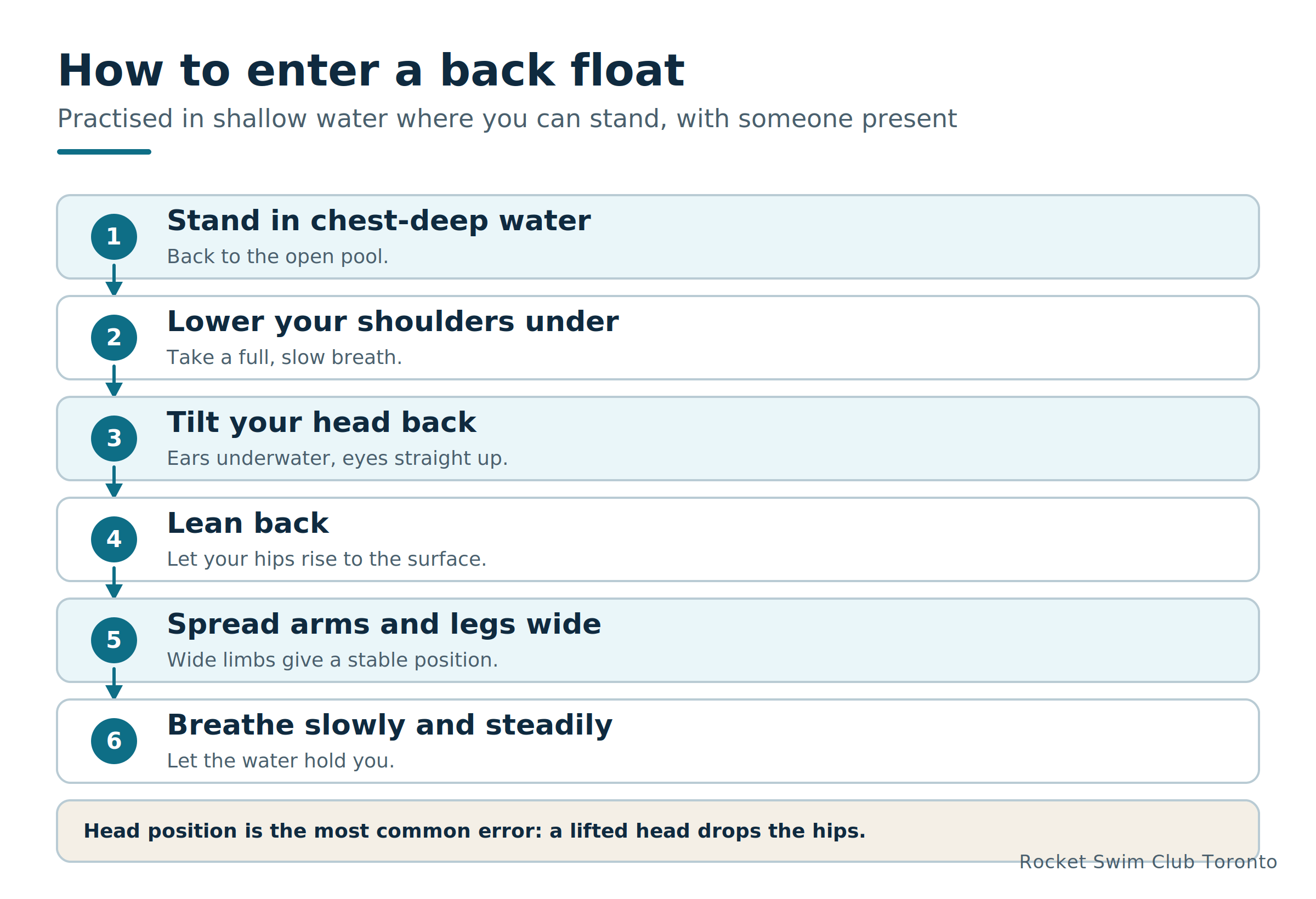
The most common error in that sequence is head position.
Where should your head be when you float on your back?
The head tilts back until the ears are submerged and the eyes look straight up at the ceiling. The head steers the rest of the body in the water. A head lifted forward to check on the feet pushes the hips down and folds the float. A head laid back flattens the body toward horizontal. The face stays clear of the water the whole time, so breathing is never interrupted.
What do you do with your arms and legs?
Arms and legs spread wide, in the shape commonly called the starfish float. The starfish float is a back float with the limbs extended away from the body, and wide limbs give more surface area and a more stable position.
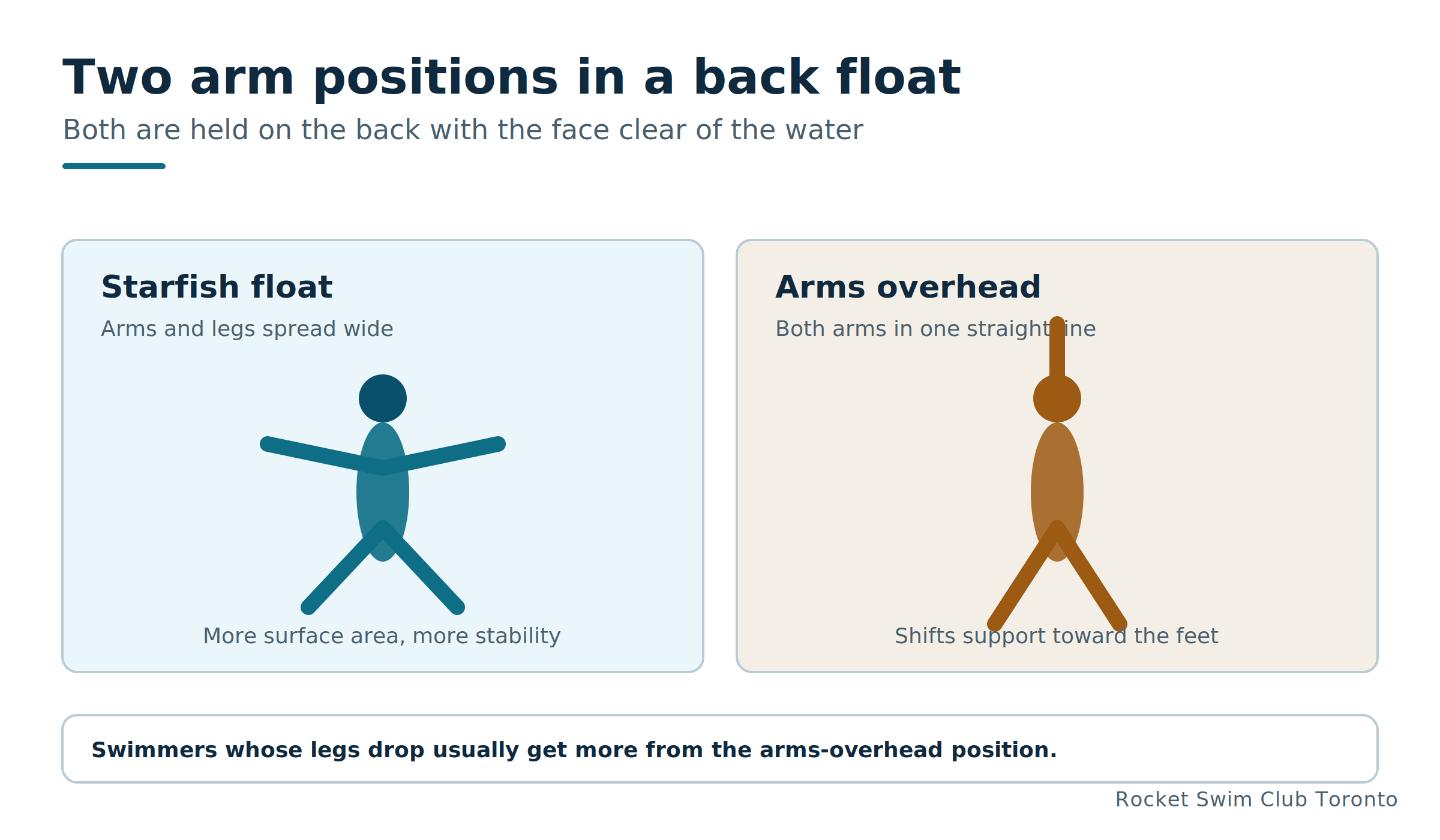
A second option moves both arms above the head into one long straight line, which shifts support toward the feet and holds the legs higher. Beginners who find the legs dropping usually get more from the arms-overhead position than from the starfish.
How do you float on your front?
The front float, also called the prone float, places the face in the water with the body extended face-down at the surface. The breath is held for the duration, so front floats are held for a few seconds at a time rather than minutes.
- Stand in chest-deep water and take a full breath.
- Place your face in the water and extend your arms forward.
- Let your feet leave the bottom and your body settle flat.
- Exhale gently through your nose if water entry is uncomfortable.
The tuck float is the easiest front variation: knees pulled to the chest, arms wrapped around the shins, face down. It requires no alignment at all, which makes it a useful first attempt for anyone who finds the flat front float unsettling. Whichever float is attempted, the same complaint follows within a few minutes.
Why do your legs sink when you float?
Your legs sink because legs are dense and hold almost no air, while your chest holds the lungs. The chest floats, the legs hang, and the body settles at an angle rather than flat. Four things decide how steep that angle is:
- Body composition. Muscle and bone are denser than water. Body fat is less dense.
- Lung volume. A fuller chest lifts the upper body and steepens the angle.
- Hip and head position. A lifted head drops the hips, and dropped hips drop the legs.
- Muscle tension. Tense muscles hold the body short and low.
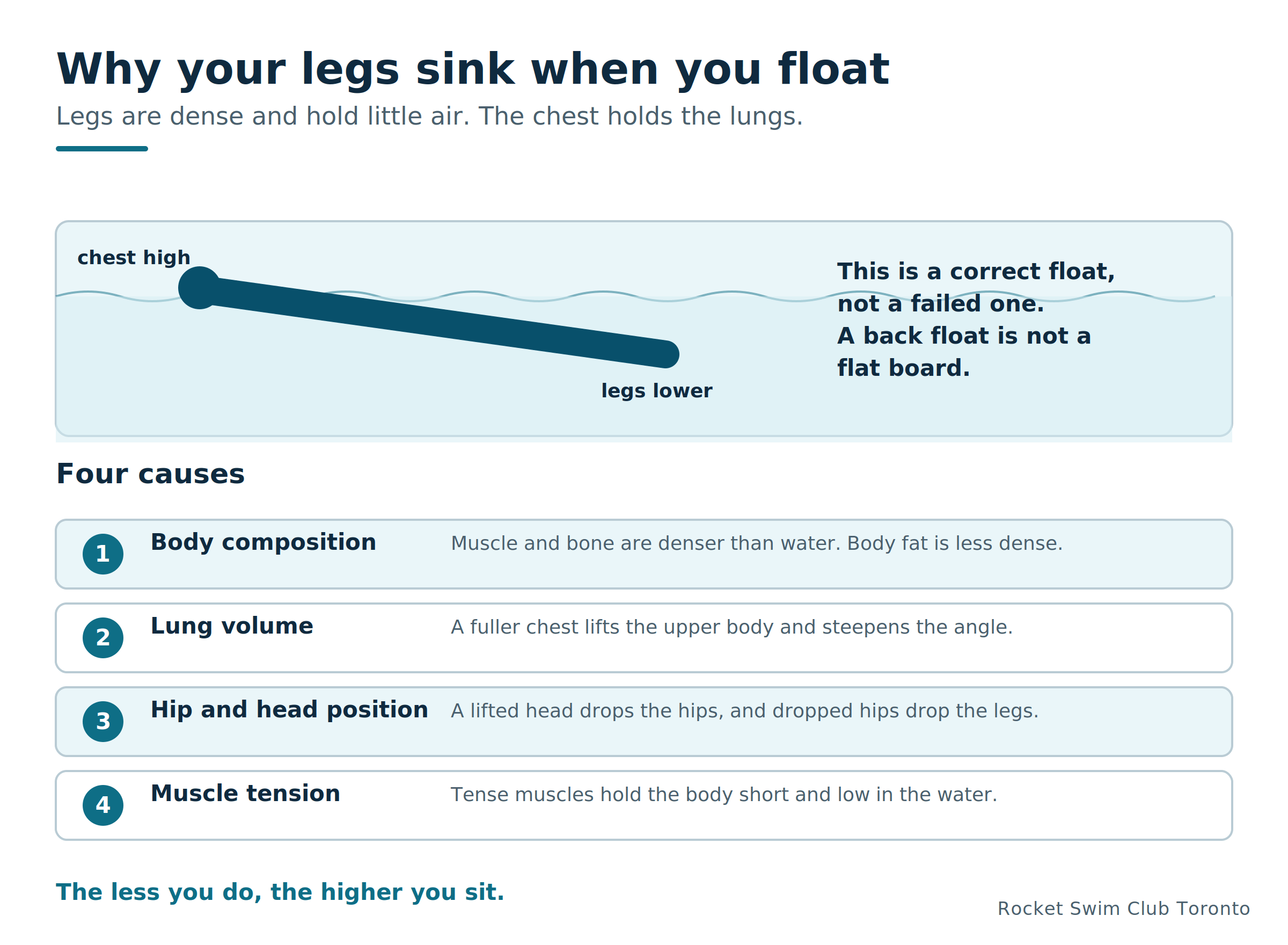
Legs sitting lower than the chest is normal. A back float is not supposed to be a flat board, and a beginner whose legs hang below the surface is floating correctly, not failing.
Does body composition change how you float?
Body composition changes how a body floats. Muscle and bone are denser than water, so people carrying more muscle mass and heavier bone density sit lower at the surface and find a flat float harder to hold. Body fat is less dense than water, so it raises buoyancy. This changes the technique a person needs, not whether they can float. Swimmers who sit low use the arms-overhead position, a fuller breath and a slower entry into the float. No body type is excluded from floating.
How does a deep breath change your float?
A full breath raises the whole body at the surface. The lungs are the largest air space in the body, and a full chest displaces more water than an empty one. Take a full breath before entering the float, then breathe slowly and shallowly on top of it rather than emptying the chest on every exhale. Holding the breath is a different thing and works against the float, because a held breath brings tension with it.
Does muscle tension make you sink?
Muscle tension makes a body sink faster. A tense body holds itself short and compact, which lowers the hips and reduces the surface the water has to push against. Fast arm movements make it worse, because sculling hard at the surface produces downward force and burns energy without adding lift. The instruction that works for most beginners is the opposite of instinct: the less you do, the higher you sit.
How do you stand up from a float?
Standing up is part of the float, not what happens after it. A beginner practises the exit in the same session as the entry, because a float you cannot leave under control is a float you will panic out of.
From a back float:
- Tuck your knees toward your chest.
- Sweep your arms forward and press down through the water.
- Bring your head forward and plant your feet on the bottom.
From a front float:
- Press both hands down and bring your knees under your hips.
- Lift your head last, once your feet are already under you.
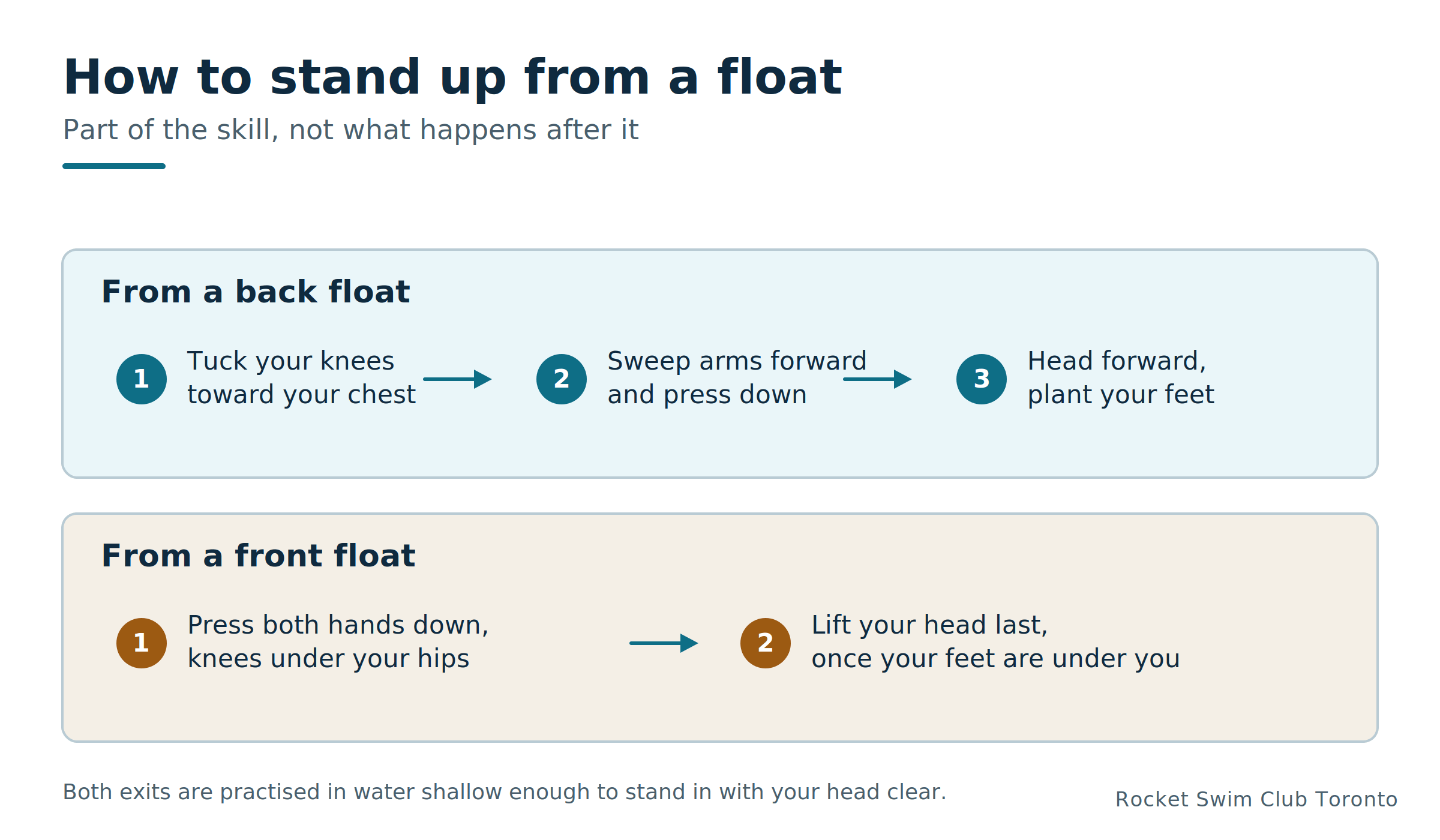
Both exits are practised in water shallow enough to stand in with your head clear of the surface. A swimmer who can hold a float but cannot stand up from it has not finished learning the skill.
Where should you practise floating?
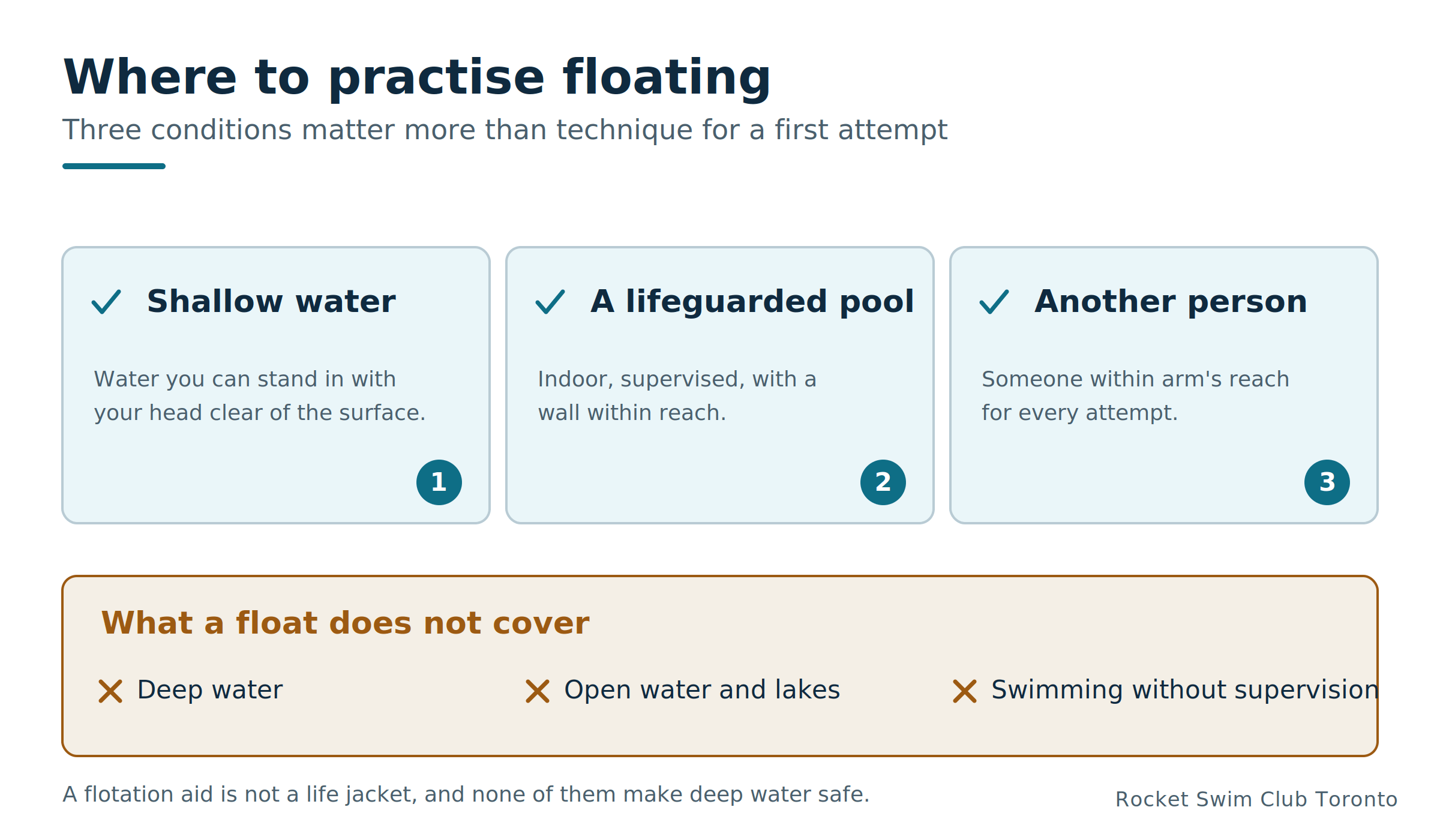
Practise floating in shallow water where you can stand with your head clear, in a lifeguarded pool, with another person within arm’s reach. Those three conditions matter more than technique for a first attempt, because the first failed float is the one that decides whether a beginner comes back.
Rocket Swim Club teaches floating as the second step of its six-step beginner sequence, after comfort in the water and before breath control, in small coach-to-swimmer groups at indoor pools in west-end Toronto (High Park, Swansea, Runnymede and Eglinton West). A $17 in-water assessment of 10 to 15 minutes places a new swimmer in the right group.
Which flotation aids help a beginner float?
No flotation aid is required to float. Aids are used to hold the correct position long enough for a beginner to feel what it should feel like, then removed.
- Pool noodle. Placed under the knees or across the back, it holds the hips up while you learn the head position.
- Kickboard. Held at the chest or under the arms, it supports the upper body during front-float practice.
- Swim vest. Worn on the torso, it holds a beginner at the surface with no positioning required.
- Pull buoy. Held between the thighs, it lifts the legs so a swimmer with sinking legs can feel a level float once.
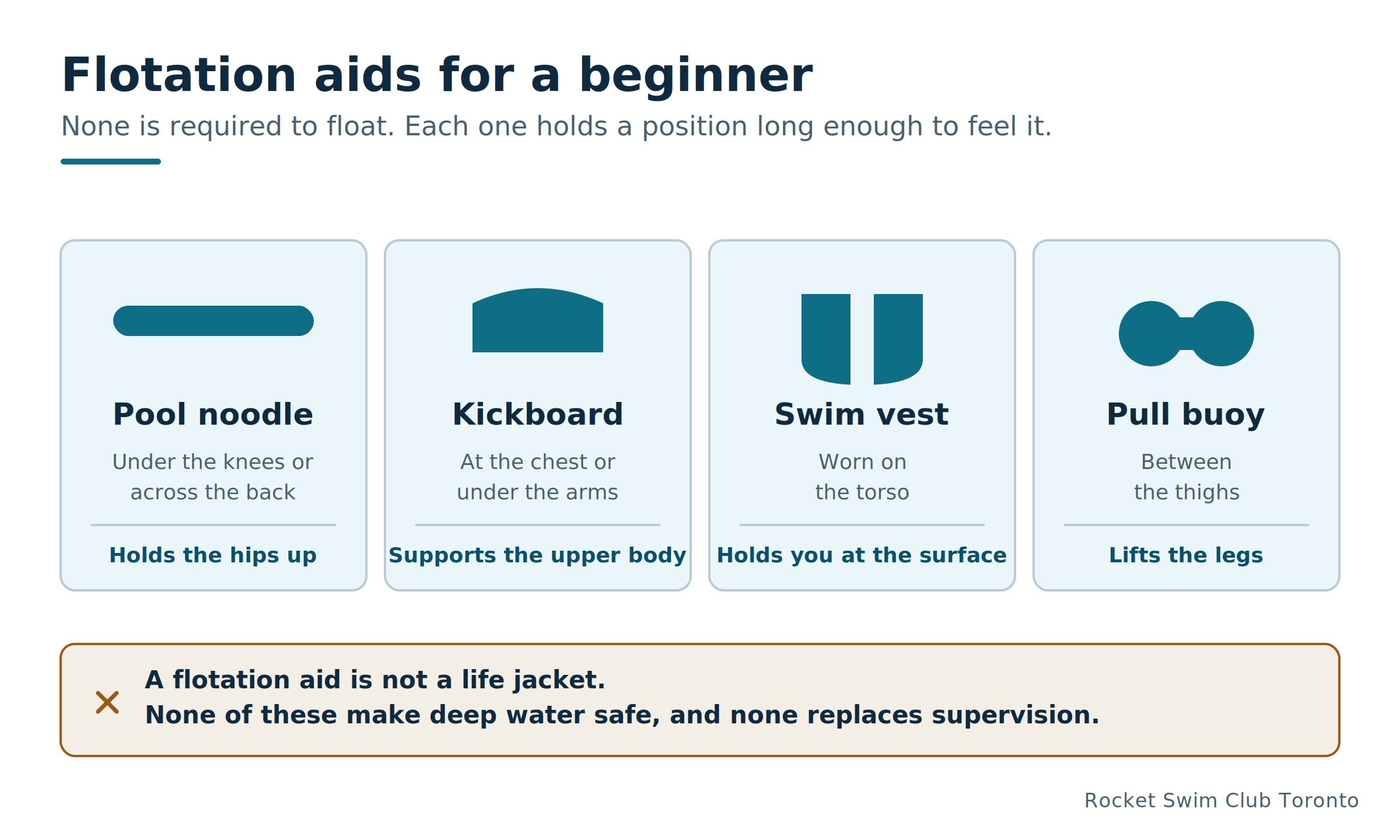
A flotation aid is not a life jacket. None of these make deep water safe, and none replace supervision.
What comes after floating?
Floating holds a position and swimming moves. The step between them is the glide: push off the wall in shallow water, hold the horizontal alignment you learned in the front float, and let the push carry you. Add a flutter kick to the glide and you have movement. Add an arm stroke to that and you have a swimming stroke.
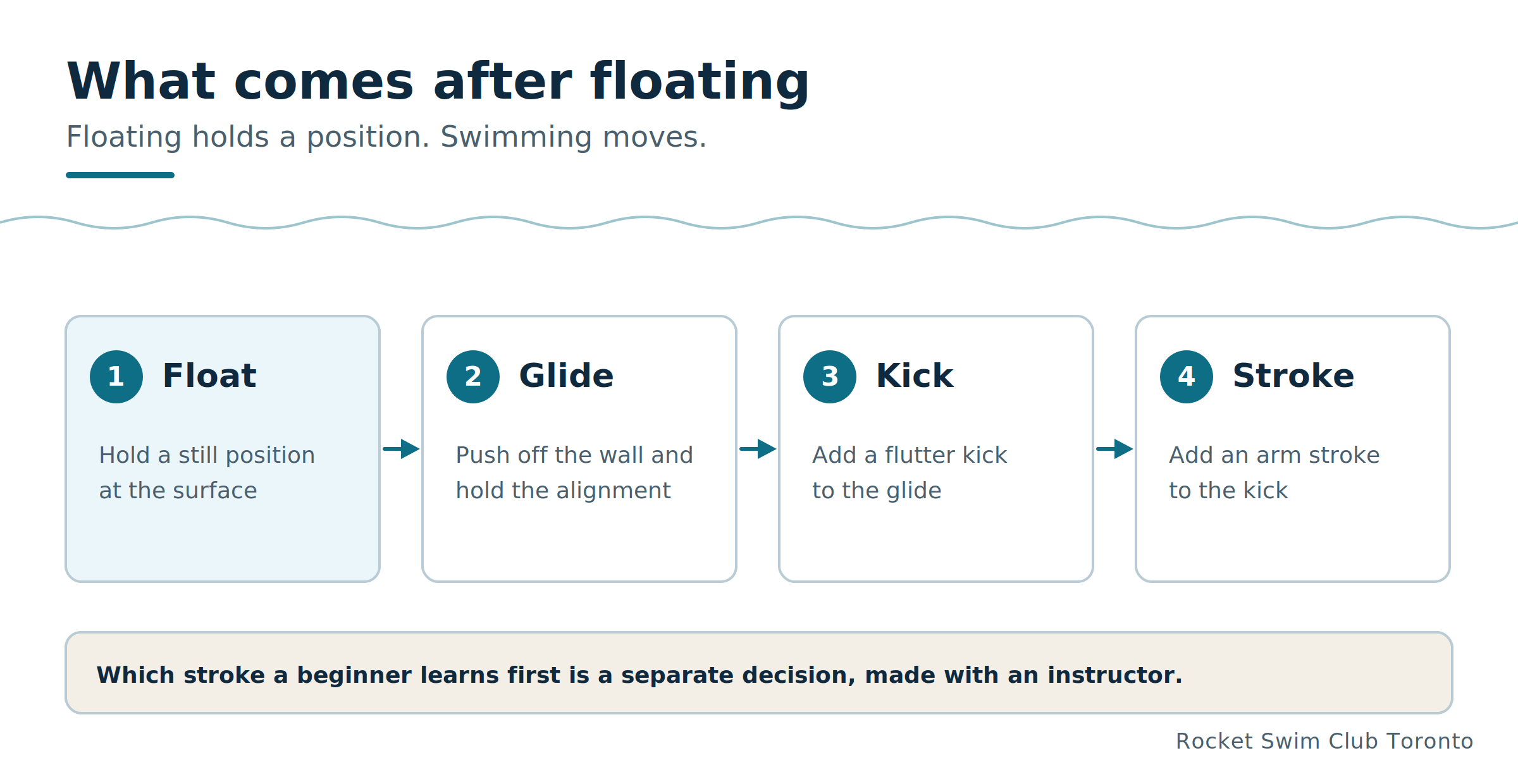
Rocket Swim Club’s published sequence runs floating, breath control, kicking, arm stroke, then putting it together, and its adult beginners typically swim a comfortable first length within 8 to 12 lessons. Which stroke a beginner learns first is a separate decision, covered in our guide to basic swimming strokes for beginners, and the skill order across the whole learn-to-swim path is set out in the Rocket Swim levels.
What floating does not do
Floating does not make deep water safe, and it does not replace supervision. A float learned in a lifeguarded pool is held in warm, still, shallow water with a wall within reach. Open water in Ontario is colder, moving, and has no bottom you can stand on, and cold water changes what a body can do within seconds of entry. Treading water is the skill that keeps a swimmer upright and breathing away from the wall, and it belongs with the broader set of water safety skills rather than with floating alone. Adults who learned to float on their own and stopped there often find the gap shows up the first time they leave the shallow end, which is what adult swimming lessons exist to close.
Common questions about floating
Can everyone float in water?
Almost everyone floats, though not everyone floats flat. People with denser bodies float lower and at a steeper angle, and some sit so low that only the face stays clear. That is still a float, and it is still enough to rest and breathe.
Is floating on your back easier than floating on your front?
The back float is easier for most beginners, because the face stays out of the water and breathing continues normally. The front float requires a held breath, which is harder to stay relaxed through.
Do you need to know how to float before you can swim?
Floating is not a prerequisite for swimming, and people who sit low in the water learn strokes without ever holding a flat float. Floating is taught first because it teaches body position and relaxation, which every stroke then uses.
Is it safe to practise floating alone?
Practise floating with another person present, in a lifeguarded pool, in water shallow enough to stand in. A beginner alone in water has no one to help if a float turns into a face-down position, which is why every first attempt belongs in recreational swimming lessons in Toronto or in supervised shallow water.