

Swimming is the only common form of exercise where the body works against water instead of against gravity, and that single difference changes what happens physically. Water supplies resistance and support at the same time, so a swimmer loads nearly every major muscle group while very little load passes through the joints.
This guide covers how water produces that effect, why swimming is called low-impact, which muscles each stroke works, what sustained swimming asks of the heart and lungs, what it does for range of motion and posture, why the properties of water suit a body that tolerates less impact, and the one thing swimming does not do. Rocket Swim Club’s adult programme includes a fitness stream built around technique, cardiovascular fitness and consistency in coached sessions.
How does water make the body work?
Water is roughly 800 times denser than air, so every movement a swimmer makes meets resistance in every direction. There is no equipment involved and no weight to select. The resistance is supplied by the medium itself, and it scales with effort: a slow arm pull meets light resistance and a fast one meets heavy resistance, from the same water. That property is why a swim can be easy or hard without anything changing except the swimmer.
What does water resistance do that air does not?
Water loads a muscle as it shortens and again as it lengthens. A muscle shortening under load is working concentrically; a muscle lengthening under load is working eccentrically.
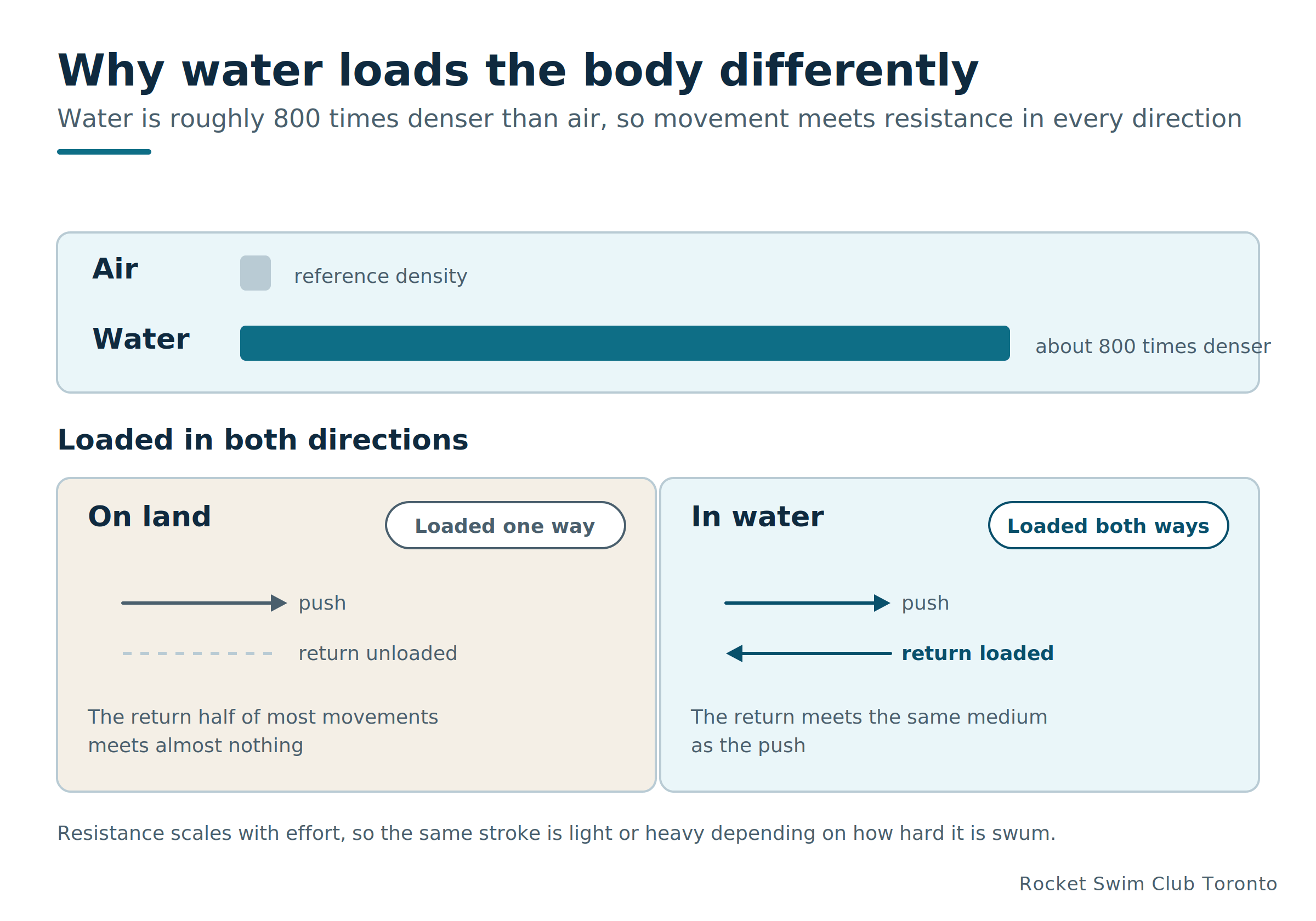
On land, the return half of most movements is unloaded … an arm swinging back through air meets almost nothing. In water, the return meets the same medium as the push. This means opposing muscle groups both work in every stroke cycle, so swimming loads the front and back of the body in the same movement rather than in separate exercises.
Why is swimming low-impact?
Swimming is low-impact because buoyancy carries most of the body’s weight, so very little load passes through the ankles, knees, hips and spine. Buoyancy is the upward force the displaced water applies to the body, and in a horizontal swimming position it supports nearly all of it. The contrast is with running, where every footfall sends a force up through the weight-bearing joints, repeated thousands of times per session. In water, that force is not present.
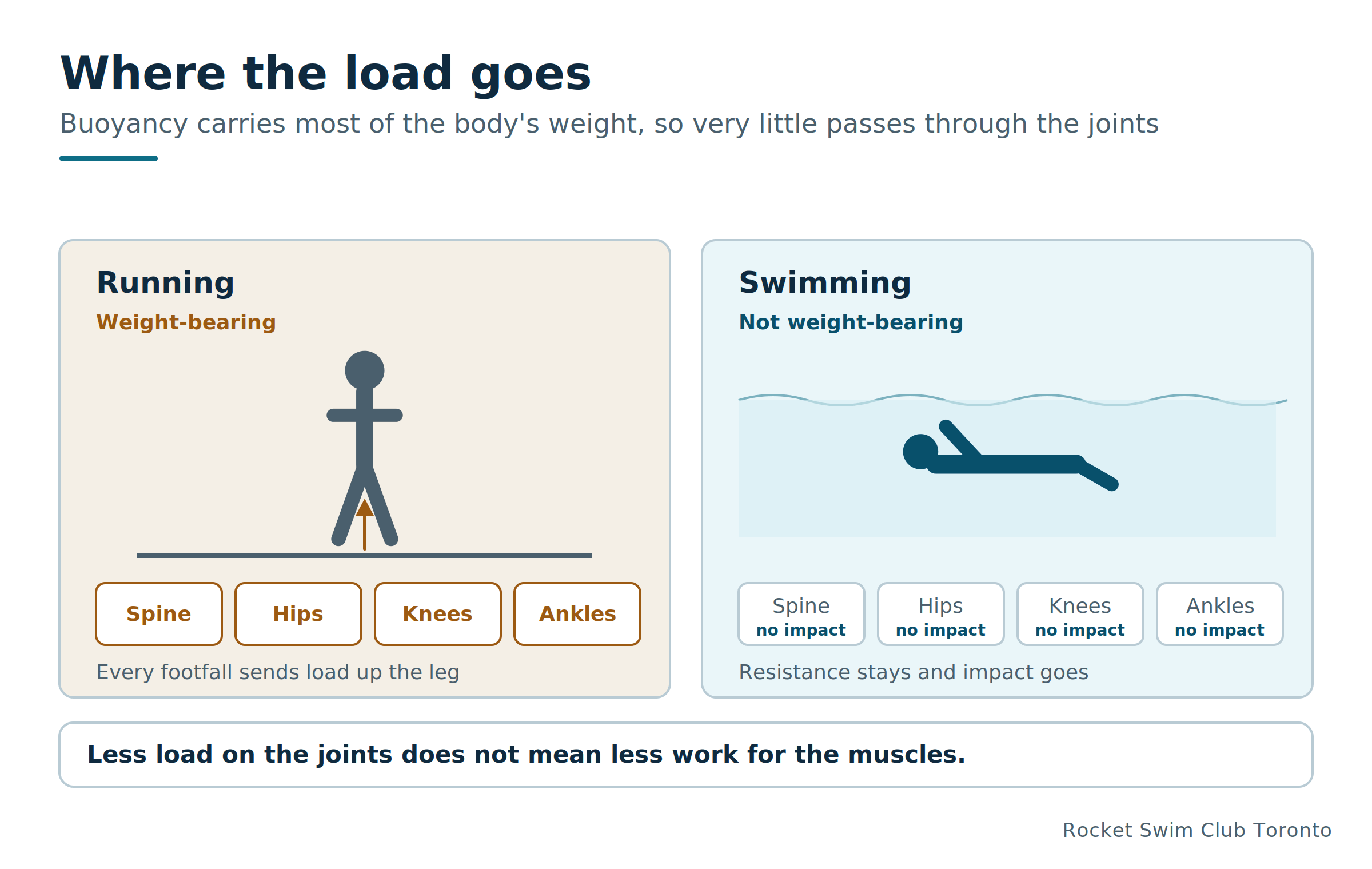
Resistance stays and impact goes, which is the whole of what “low impact” describes physically: buoyancy reduces the load passing through weight-bearing joints, while water resistance still builds strength without impact. Readers looking at swimming in relation to a specific diagnosis will find that covered separately in swimming for health conditions, and anyone managing a condition should take individual guidance from their own healthcare professional. Less load on the joints does not mean less work for the muscles.
Which muscles does swimming work?
Swimming works nearly every major muscle group, and the balance between them shifts with the stroke. The upper body supplies most propulsion through the back (latissimus dorsi), shoulders (deltoids), chest (pectoralis major) and the back of the upper arm (triceps), with the rotator cuff stabilising the shoulder through each arm recovery. The lower body contributes through the glutes, hip flexors, quadriceps, hamstrings, inner thigh muscles (adductors) and calves. The core works throughout, in every stroke, without exception.
Which muscles does each stroke work?
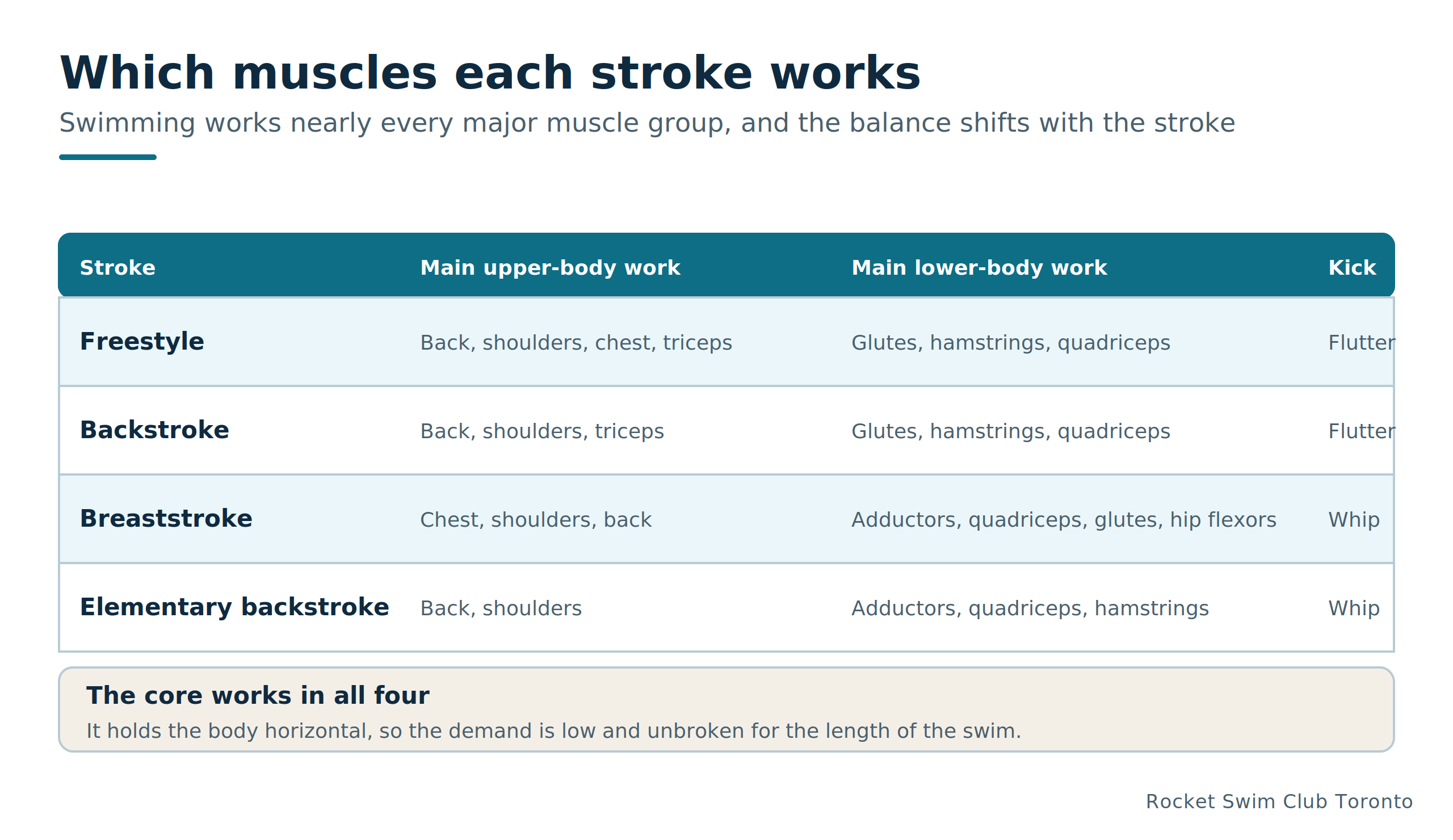
The table below sets out four recreational strokes against three things: the upper-body muscles that do most of the work, the lower-body muscles that do most of the work, and the kick each one uses.
| Stroke | Main upper-body work | Main lower-body work | Kick |
|---|---|---|---|
| Freestyle | Back, shoulders, chest, triceps | Glutes, hamstrings, quadriceps | Flutter kick |
| Backstroke | Back, shoulders, triceps | Glutes, hamstrings, quadriceps | Flutter kick |
| Breaststroke | Chest, shoulders, back | Adductors, quadriceps, glutes, hip flexors | Whip kick |
| Elementary backstroke | Back, shoulders | Adductors, quadriceps, hamstrings | Whip kick |
What does swimming do for the core?
The core works continuously in swimming, because it is what holds the body horizontal. Unlike a core exercise performed in sets, the demand in swimming is low and unbroken for the length of the swim. Rotation adds to it: freestyle and backstroke roll the body toward each pulling arm, and that rotation is controlled by the oblique muscles. A core that tires shows up as hips dropping below the surface, which increases drag and makes the same stroke cost more.
Does swimming build strength or endurance?
Swimming builds muscular endurance more than maximum strength. Muscular endurance is the ability of a muscle to repeat an effort many times without fatiguing. Water resistance is moderate and continuous rather than heavy and brief, and that pattern develops repeatability rather than peak force.
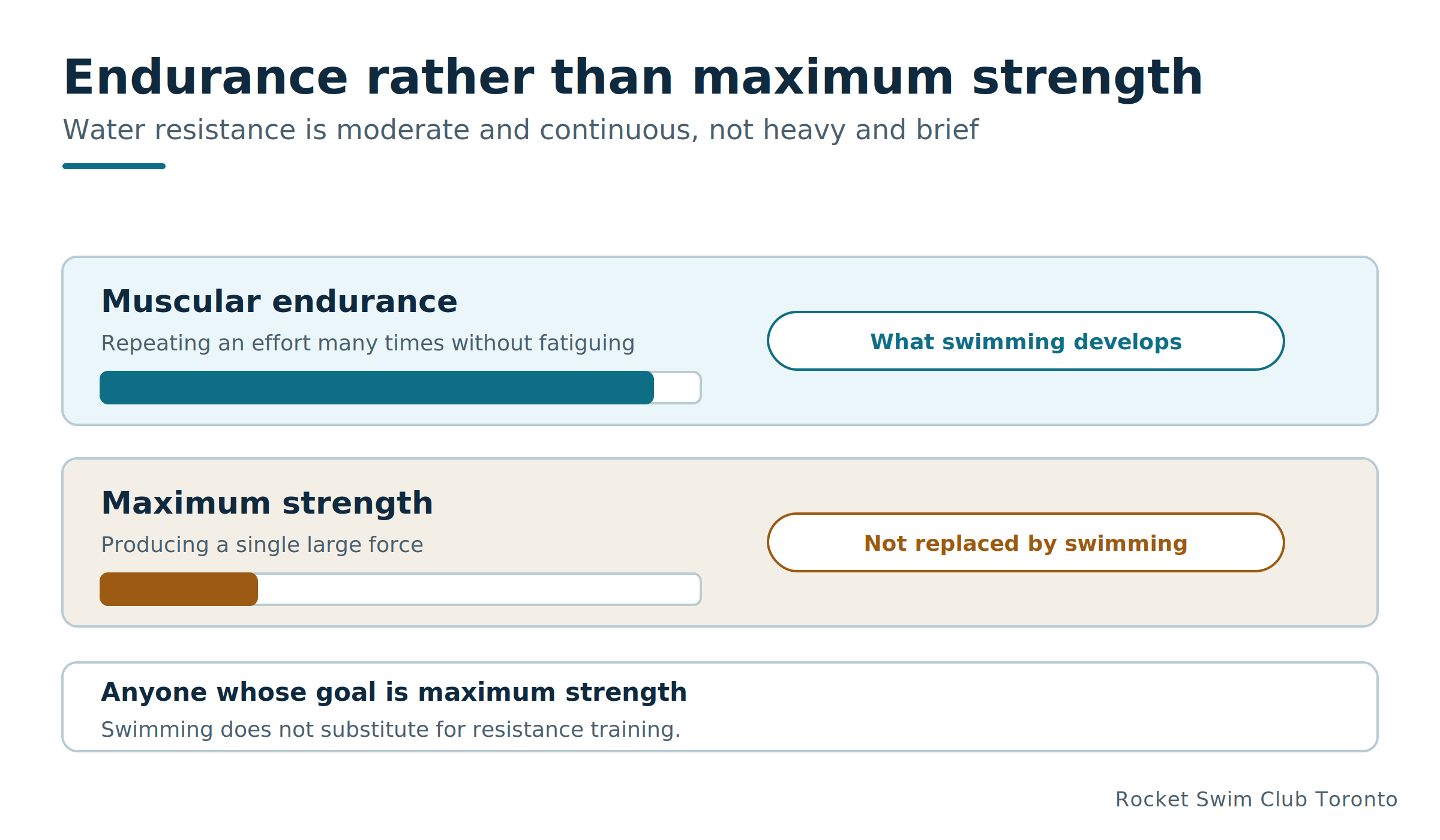
Swimming does not replace resistance training for anyone whose goal is maximum strength. What it produces instead is a body that can keep going for the length of a session with the load spread across most of the major muscle groups at once.
What does swimming do for the heart and lungs?
Swimming raises heart rate and breathing rate and holds them there, which is what makes it aerobic exercise. Cardiorespiratory fitness is the capacity of the heart, lungs and circulation to deliver oxygen to working muscles over a sustained period. Sustained whole-body movement raises oxygen demand, and the heart and lungs answer that demand. Two things make swimming feel different from land cardio at the same effort: the body is horizontal, so the heart is not pumping against the same vertical column of blood, and water pressure sits on the chest throughout. The broader picture of why people take up swimming is covered in the health benefits of swimming.
What swimming does for breathing
Swimming requires breathing on a rhythm the stroke sets rather than one the swimmer chooses. In freestyle the breath arrives when the head turns; in breaststroke it arrives at the top of the pull.
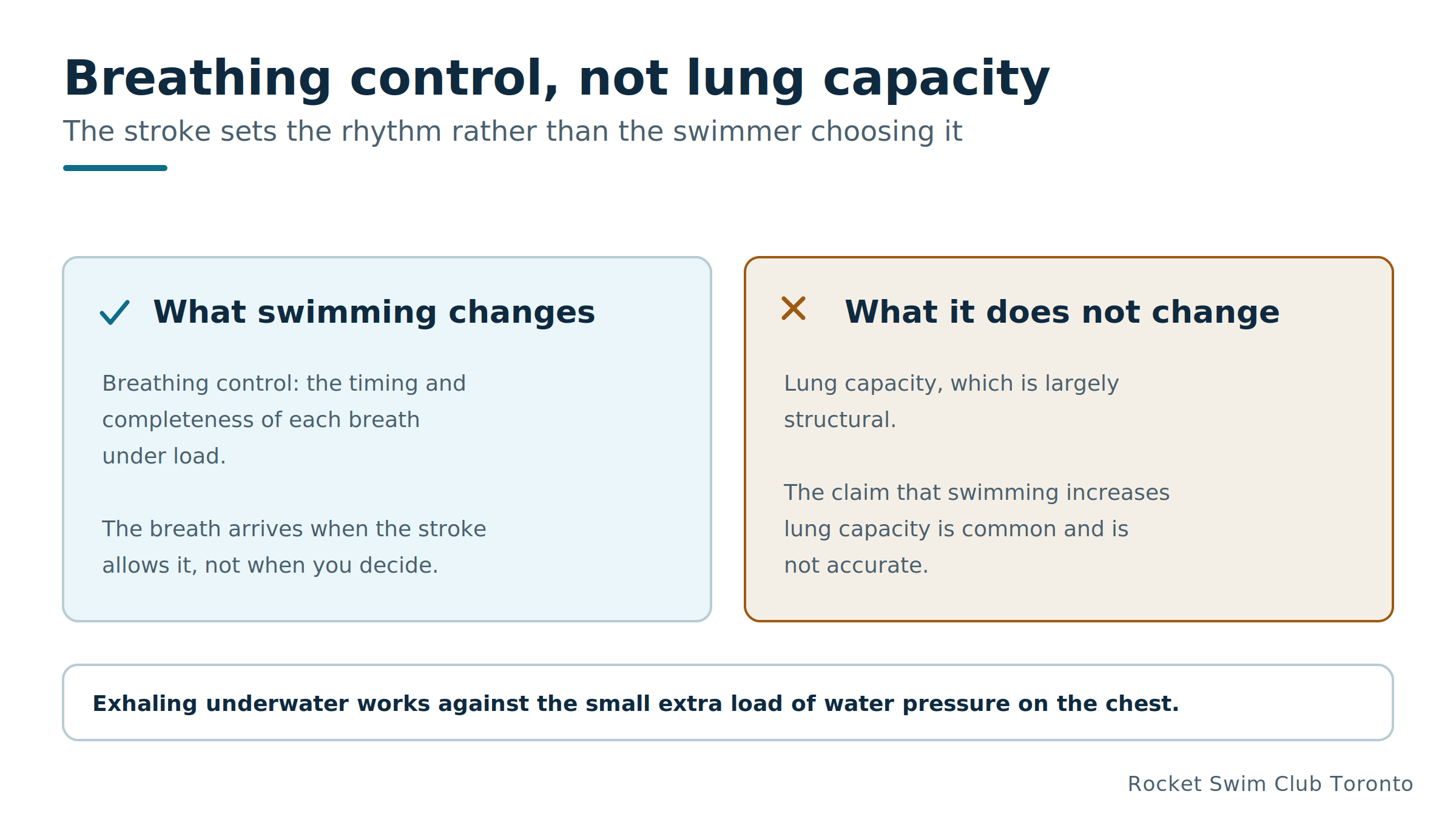
Exhalation happens underwater against the small extra load of water pressure on the chest. The effect is on breathing control, which is the timing and completeness of each breath under load. Lung capacity itself is largely structural and is not something a swim changes.
How does swimming affect flexibility and posture?
Swimming moves the shoulders and hips through a wide range of motion on every stroke cycle. Range of motion is how far a joint travels between its limits. A freestyle or backstroke arm rotates through more range than almost anything in daily life, and it does so under light, even load rather than at the end of a stretch. The hips extend and flex continuously in the kick. Because the body is horizontal, the spine carries none of the compressive load it holds when standing or sitting, and the muscles across the upper back work to hold the shoulders in position rather than to resist a forward pull. Swimmers commonly notice this as a looser upper back after a session.
Why do the physical properties of water suit an ageing body?
Water supplies resistance without impact, and impact is the part that many bodies tolerate less well over time. Cartilage and connective tissue take longer to recover from repeated impact loading as a body ages, and buoyancy removes that loading entirely while leaving the resistance intact.
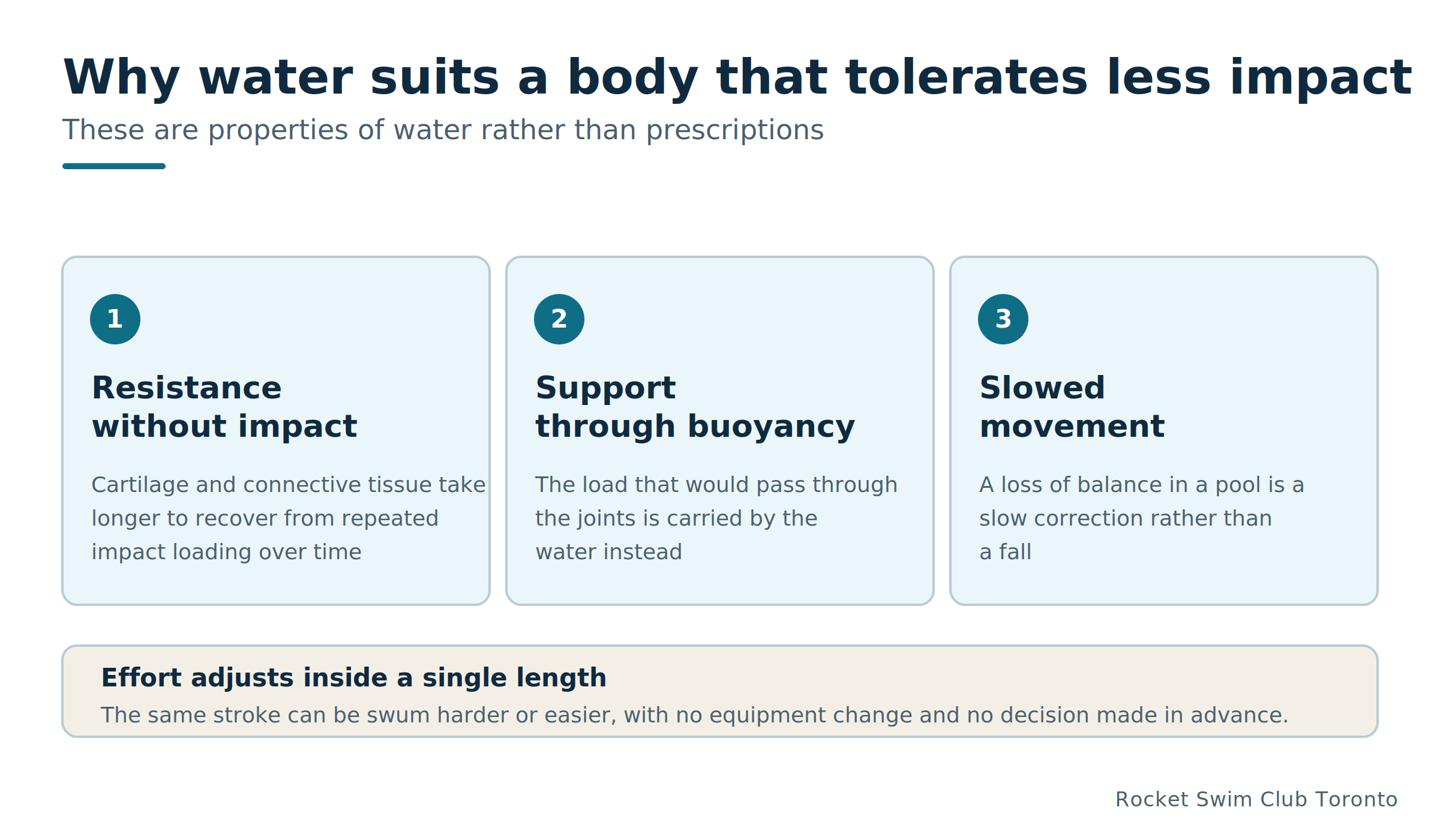
Water also slows every movement, so a loss of balance in a pool is a slow correction rather than a fall. Effort can be adjusted within a single length by swimming the same stroke harder or easier, with no equipment change and no decision made in advance. These are properties of water rather than prescriptions, and they apply to any body that needs load without impact.
What swimming does not do
Swimming is not a weight-bearing exercise, so it does not load the skeleton the way walking, running or lifting does. Bone tissue responds to the forces that pass through it, and buoyancy removes most of those forces. A swimmer who wants that kind of loading gets it from land-based activity, not from more swimming.
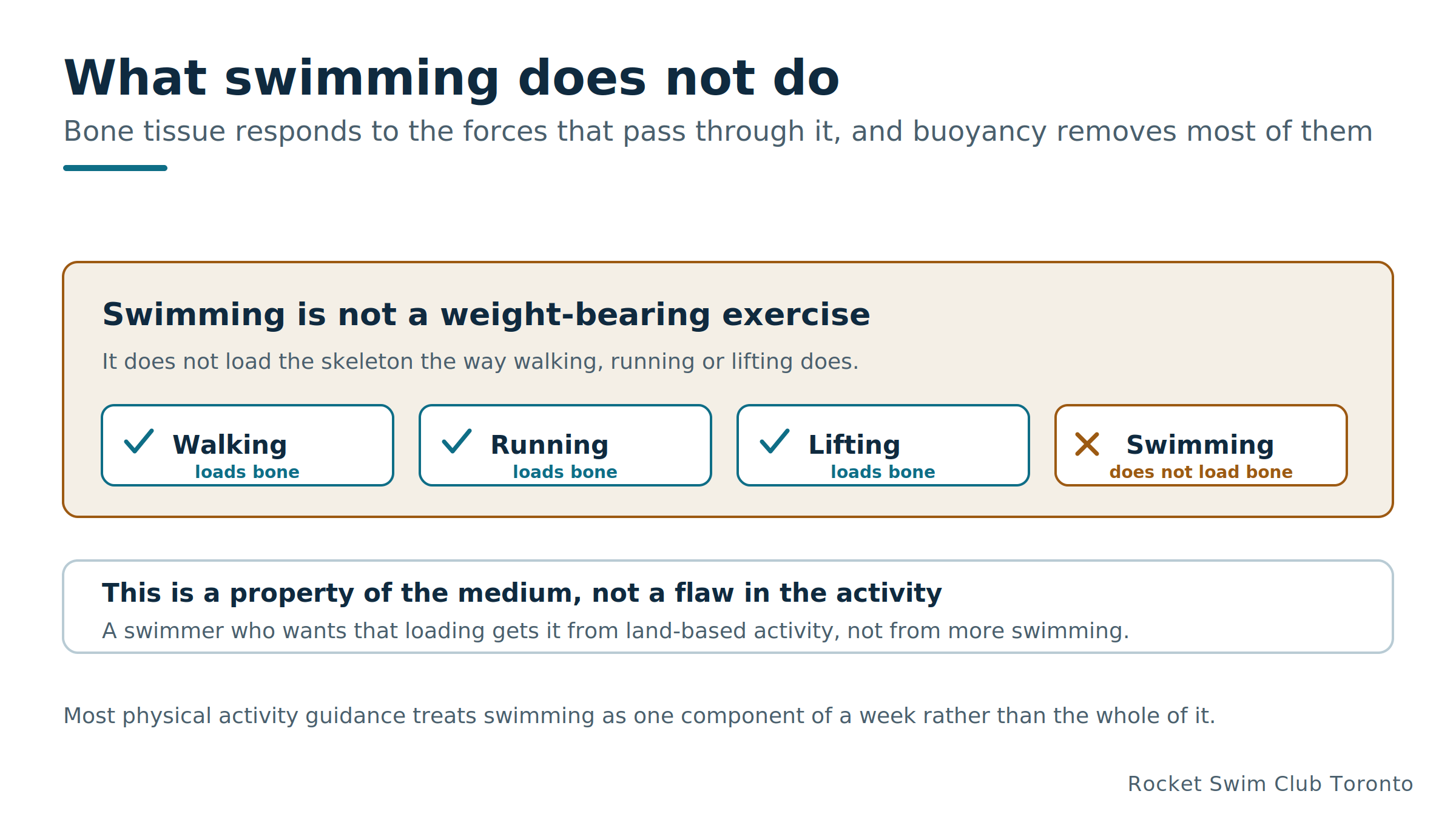
This is a property of the medium rather than a flaw in the activity, and it is the reason most physical activity guidance treats swimming as one component of a week rather than the whole of it.
How much swimming counts as physical activity?
The Canadian 24-Hour Movement Guidelines for Adults, published in 2020 by the Canadian Society for Exercise Physiology with ParticipACTION, recommend that adults aged 18 to 64 accumulate at least 150 minutes per week of moderate to vigorous aerobic physical activity, along with muscle-strengthening activity using major muscle groups at least twice a week. Swimming counts toward the aerobic total whenever it is swum at moderate to vigorous intensity.
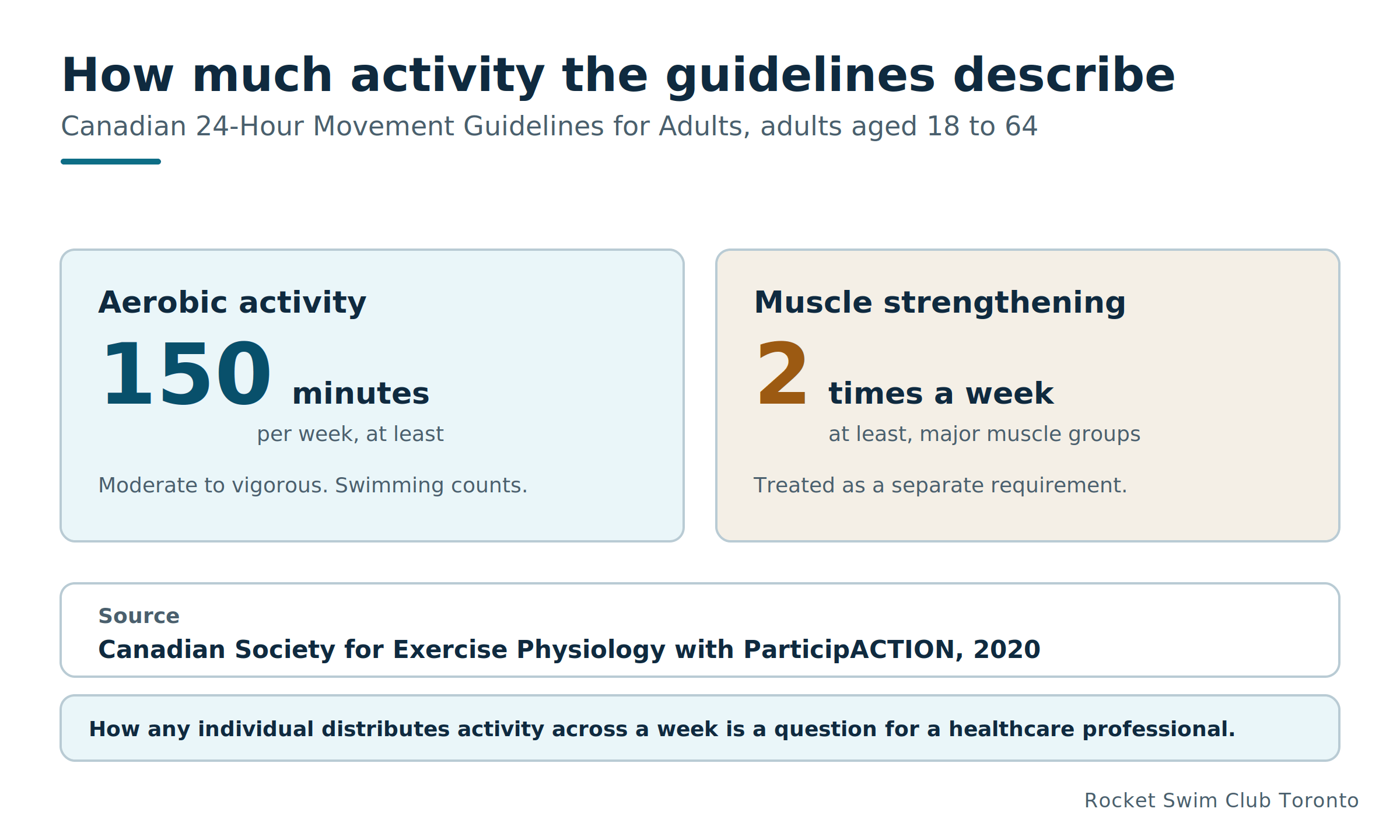
It contributes to the muscle-strengthening side as well, though the guidelines treat that as a separate requirement rather than one aerobic activity can fully absorb. How any individual should distribute activity across a week is a question for a healthcare professional who knows their circumstances.
Where technique changes what you get from a swim
Technique decides how much of a swim’s effort turns into movement. A swimmer with dropping hips spends a large share of their effort dragging water rather than crossing the pool, and that effort is not free … it is simply spent without result. Which stroke a swimmer uses also shifts the load, as the table above shows, and a swimmer with only one stroke loads the same pattern every session. The stroke options are set out in basic swimming strokes for beginners. Rocket Swim Club’s adult programme runs a fitness stream built around technique, cardiovascular fitness and consistency, with structured sessions and adaptable challenge, which is what adult swimming lessons exist to supply for swimmers who want more from the same time in the water.
Common questions about the physical benefits of swimming
Is swimming a full body workout?
Swimming works nearly every major muscle group in a single activity, with the upper body supplying most propulsion, the lower body contributing through the kick, and the core working continuously to hold the body horizontal.
Does swimming build muscle?
Swimming builds muscular endurance, which is the capacity to repeat an effort. It applies moderate continuous resistance rather than the heavy brief loading that develops maximum strength, so it does not substitute for resistance training.
Is swimming enough exercise on its own?
Swimming covers the aerobic side of physical activity fully and contributes to muscular endurance. It does not supply weight-bearing load, so most activity guidance treats it as one part of a week rather than the whole.
Is swimming good for older adults?
The physical properties of water … resistance without impact, support through buoyancy, and slowed movement … suit bodies that tolerate less repeated impact. Starting points are set by a short in-water assessment ($17, 10 to 15 minutes) at recreational swimming lessons in Toronto, which places a swimmer in a small coached group at an indoor pool in the west end of the city.